Turmeric powder usually holds a few per cent curcumin by weight. FSSAI's standard asks for at least 2.0%, a small Indian survey of market powders found about 0.65% to 3.6%, and most of the turmeric varieties released by ICAR-IISR (the Indian Institute of Spices Research) list 4.3% to 6.5%. A figure such as 6%+ sits at the high end of that range, but it only means something once you know how it was measured.
What curcumin is
Curcumin is the main yellow pigment in turmeric. It belongs to a small family called curcuminoids: curcumin, demethoxycurcumin and bisdemethoxycurcumin, with curcumin the largest share. When a pack or a lab report says "curcumin", it may mean curcumin alone or all three together, and those two numbers are not the same.
Typical curcumin levels in Indian turmeric
| Source | What it measures | Level reported |
|---|---|---|
| FSSAI standard for turmeric powder | Colouring power as curcuminoids, dry basis (the legal minimum) | Not less than 2.0% |
| A CSIR lab's survey of a few market powders, 2008 | Curcumin alone, by thin-layer chromatography | 0.65% to 3.6% |
| Most varieties released by ICAR-IISR | Curcumin, as listed by the institute | 4.3% to 6.5% |
| Light-coloured varieties, per ICAR-IISR | Curcumin, as listed by the institute | 2% to 3% |
| Review articles | Curcuminoids in turmeric overall | 2% to 9% |
The reviews put the spread down to variety, soil and climate, and a 2025 study (below) shows that handling matters too. The rows are not like for like, because each uses its own method and definition.
How curcumin is measured, and why labs disagree
There are two common methods. A spectrophotometer dissolves the curcuminoids in a solvent and reads how strongly the solution absorbs light near 425 nm. It gives one colour-based total for all the curcuminoids, and other pigments in the extract can add to the reading. HPLC (high-performance liquid chromatography) separates the extract into its parts and measures curcumin, demethoxycurcumin and bisdemethoxycurcumin one by one, which is why many analysts prefer it. A 1992 comparison in turmeric rhizomes found that the spectrophotometric method reported more curcumin than HPLC.
Two labs can therefore give two honest numbers for the same powder:
- What is counted. Curcumin alone reads lower than total curcuminoids.
- The method. A colour reading and a separated reading will not match exactly.
- The extraction. Solvent, particle size and temperature all change how much pigment comes out of the powder.
- The basis. FSSAI states its figure on a dry basis. A powder with 10% moisture that tests 5.4% as sold would read 6.0% on a dry basis.
- The powder itself. Curcumin is sensitive to light. In a 2025 HPLC study, turmeric slices dried six ways ranged from 2.6% curcumin (dried in direct sun) to 3.8% (freeze-dried or microwave-dried), and the authors blame UV light, heat and oxygen. Storage matters too; see our storage guide.
When you compare packs, ask three things: which method, whether the figure is curcumin or total curcuminoids, and on what basis. Our guide to reading a turmeric powder label covers the rest of the pack.
What 6% or more means in the kitchen
Colour. Curcumin is the pigment, so more curcumin generally means a deeper yellow. In the 2025 study the yellowness of the powders tracked their curcumin closely across 18 samples, and the authors say a bright yellow points to more curcumin. In practice a deeper haldi (turmeric) colours dal (cooked lentils), rice and milk from a smaller spoonful, so add it a pinch at a time. Colour is not a measurement, though: an added dye can fake a deep shade, and natural light-coloured varieties exist.
Flavour and aroma. These come mainly from the essential oil, not from curcumin. ICAR-IISR lists essential oil as a separate figure (6.0% to 7.0% for several of its varieties) and describes its light-coloured variety, at 2% to 3% curcumin, as having a unique flavour. A high curcumin number tells you about colour, not about aroma.
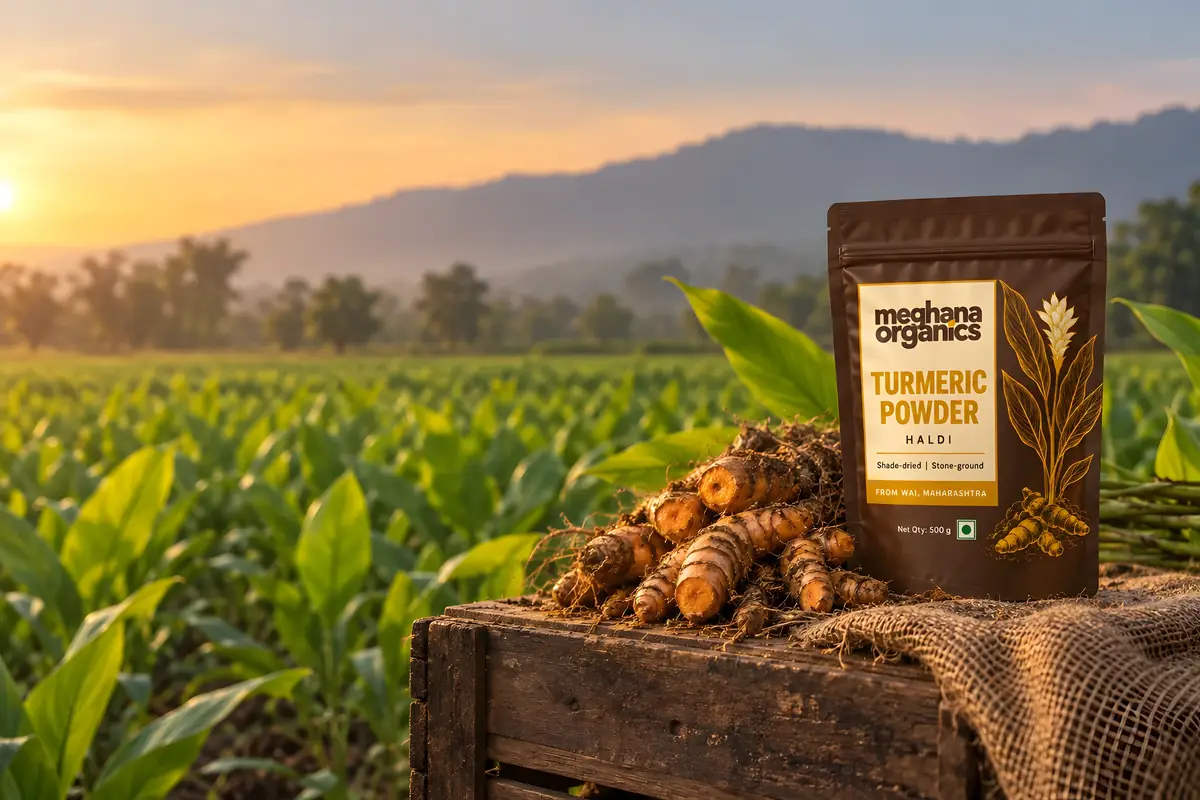
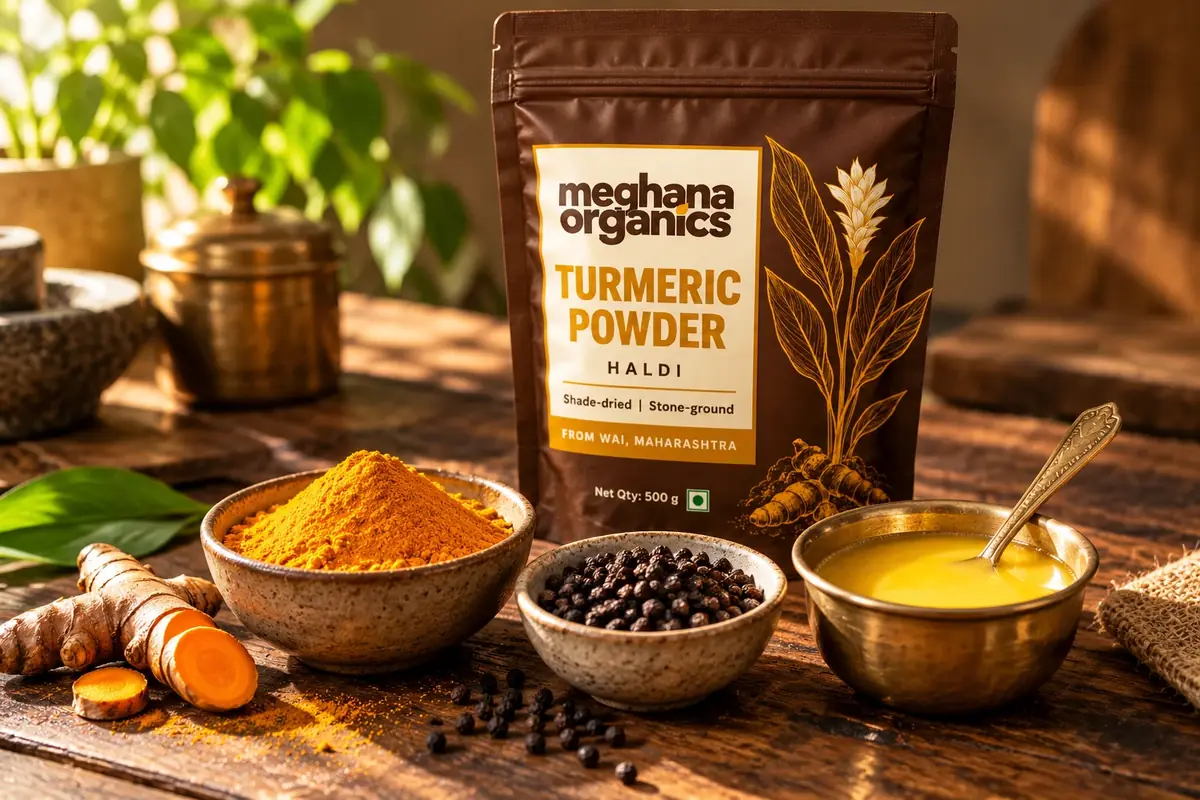
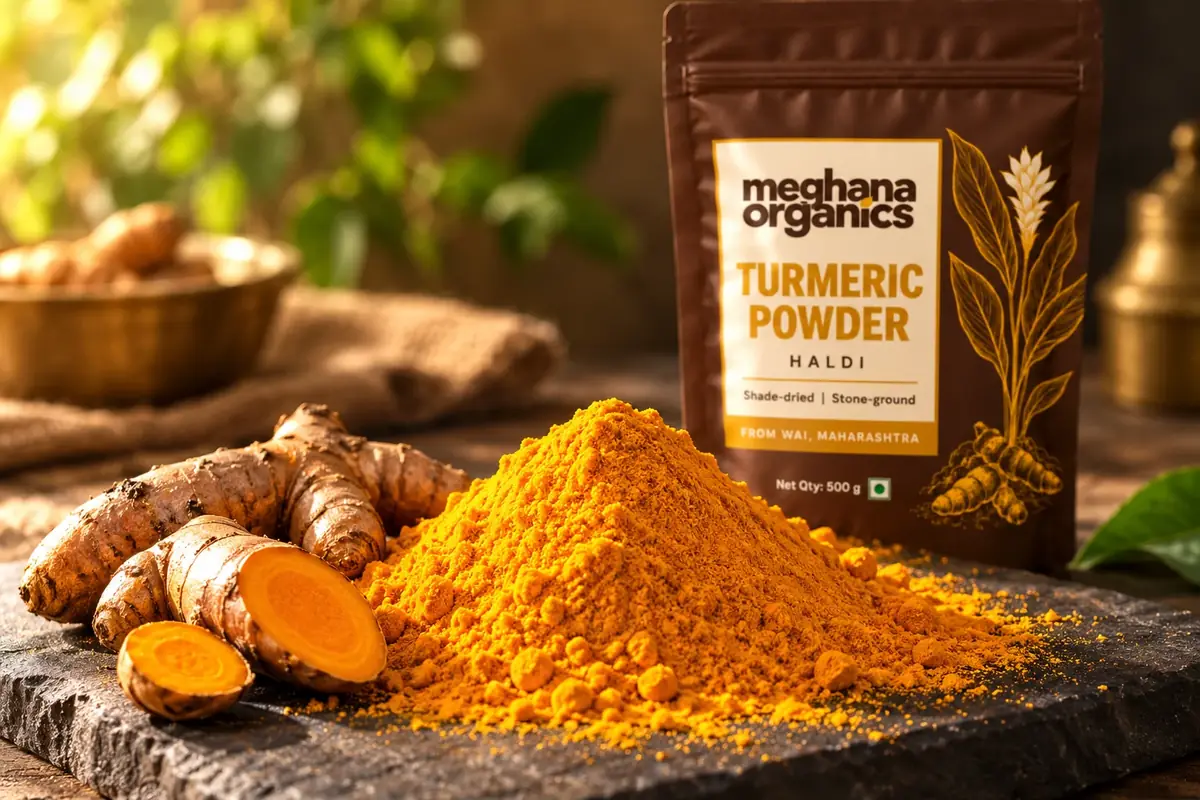
Our Turmeric Powder (Haldi) comes from our family's farm in Wai, Maharashtra. It is shade-dried and stone-ground, with no added colour, fillers or preservatives. The 6%+ curcumin on the pack is our own figure, so ask the same three questions of it as you would of any other pack.
Curcumin as a natural antioxidant
Curcumin is a natural antioxidant: in laboratory tests it neutralises free radicals, which is what being an antioxidant means. That is the idea behind our antioxidant protection collection. It is a property of the compound in a test tube. Most curcumin studies use concentrated extracts at doses far above cooking amounts, so a spoon of haldi in food is not the same thing; our post on what the research says explains how to read those studies.
A higher curcumin number is no reason to eat more haldi than you cook with. A food, not a medicine: if you are pregnant or nursing, take regular medication or have a health condition, check with your doctor before taking more than cooking amounts.
Sources
- FSSAI, Compendium of Food Product Standards, chapter 2.9: turmeric powder standard (2.9.18)
- ICAR-IISR (Indian Institute of Spices Research), spice varieties released, turmeric
- Kotra, Satyabanta and Goswami, A critical review of analytical methods for determination of curcuminoids in turmeric, J Food Sci Technol (2019)
- Dixit, Khanna and Das (CSIR Indian Institute of Toxicology Research), curcumin and dyes in market turmeric powders by HPTLC, J AOAC Int (2008)
- Shahimoridi et al., Drying techniques for turmeric: effects on colour, curcumin and essential oil, Food Chemistry: X (2025)
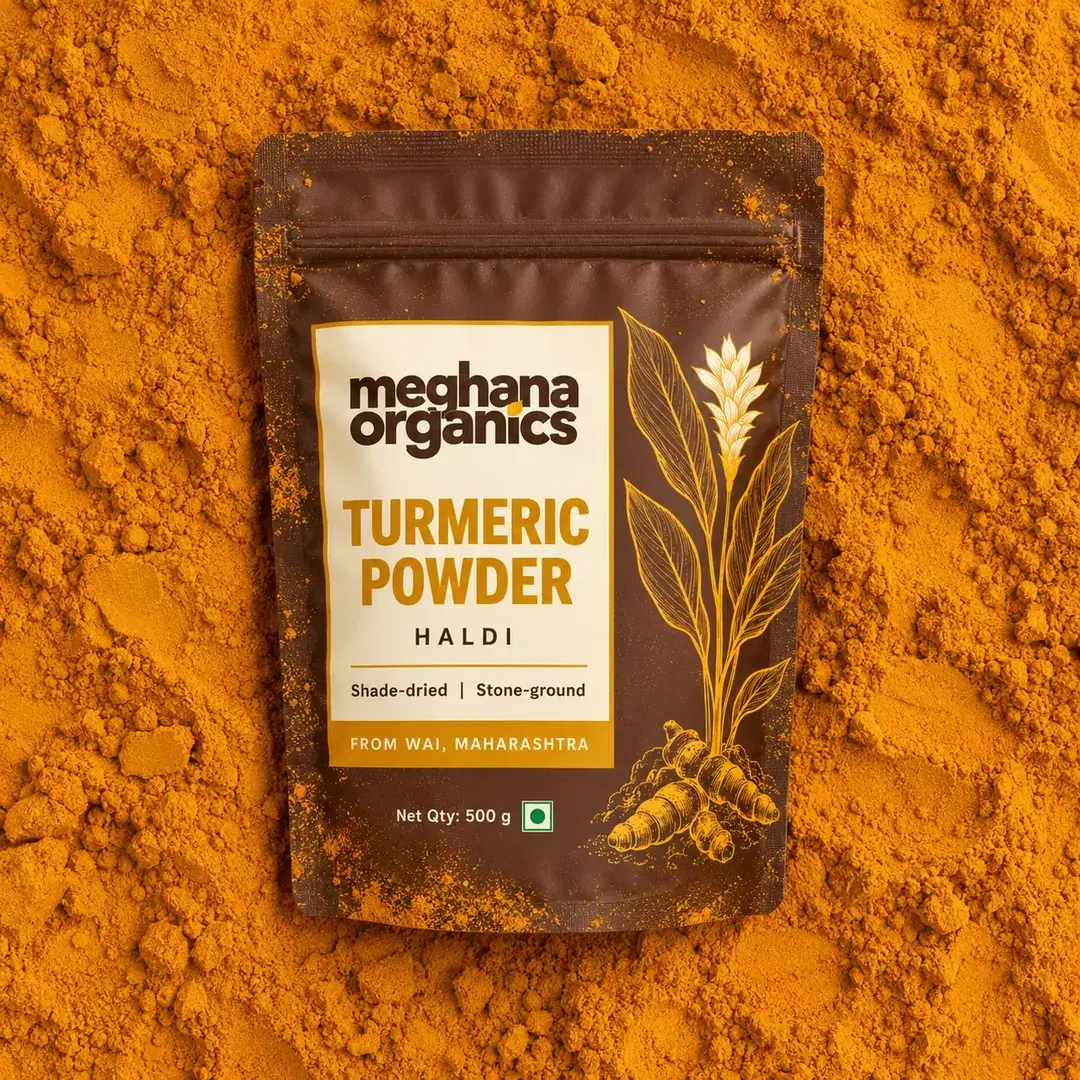
Turmeric Powder (Haldi)
From our family farm in Wai, Maharashtra. Shade-dried and stone-ground, with nothing added. 250g ₹299, 500g ₹549, 1kg ₹999.
Written by Meghana Organics Team
We are the family behind Meghana Organics. Our haldi grows on our farm in Wai, Maharashtra, and we cook with it every day. Here we write about how it is made, how to choose and store it, and how we use it.