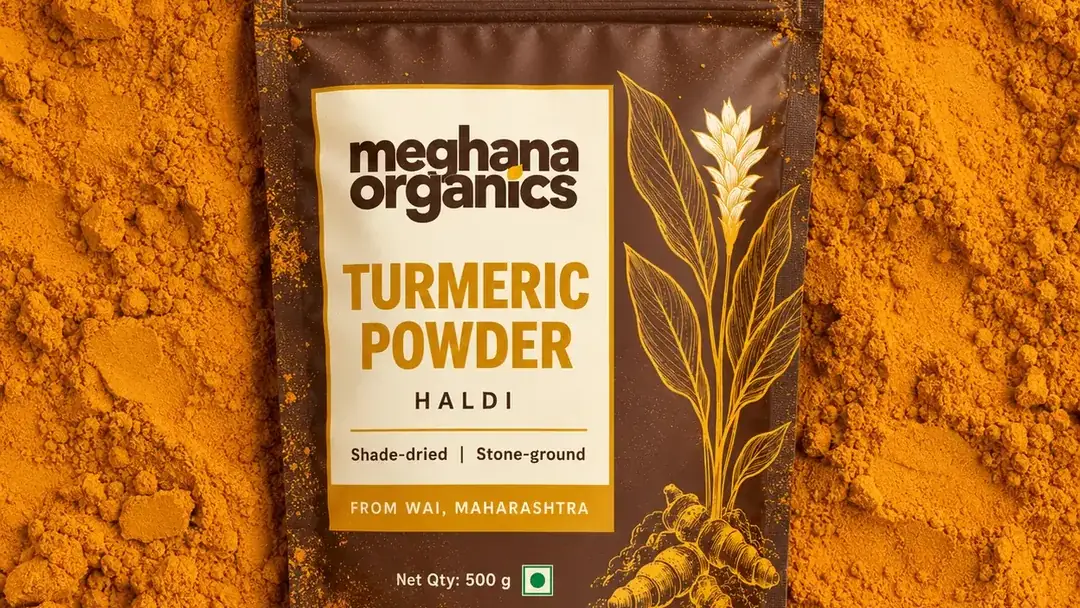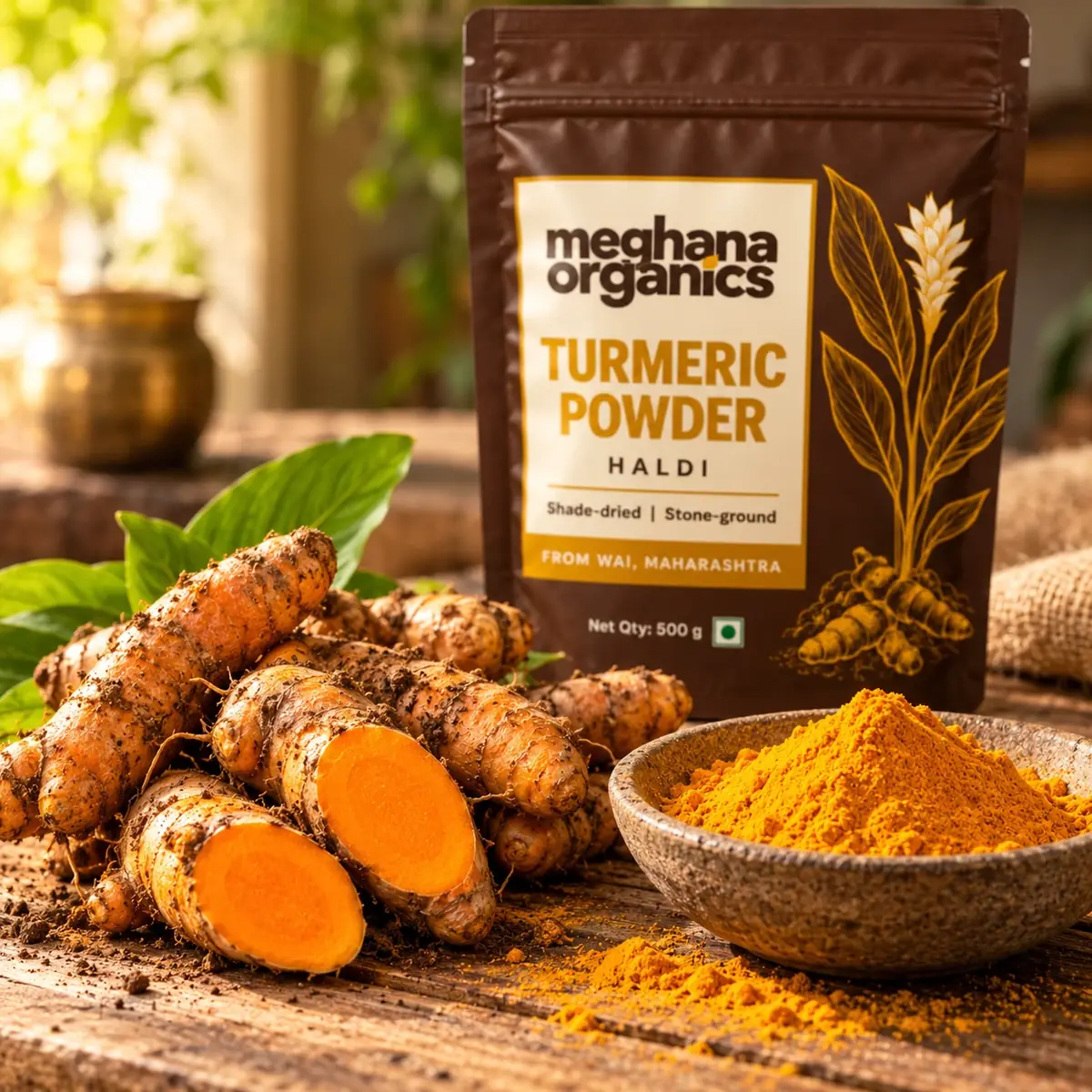
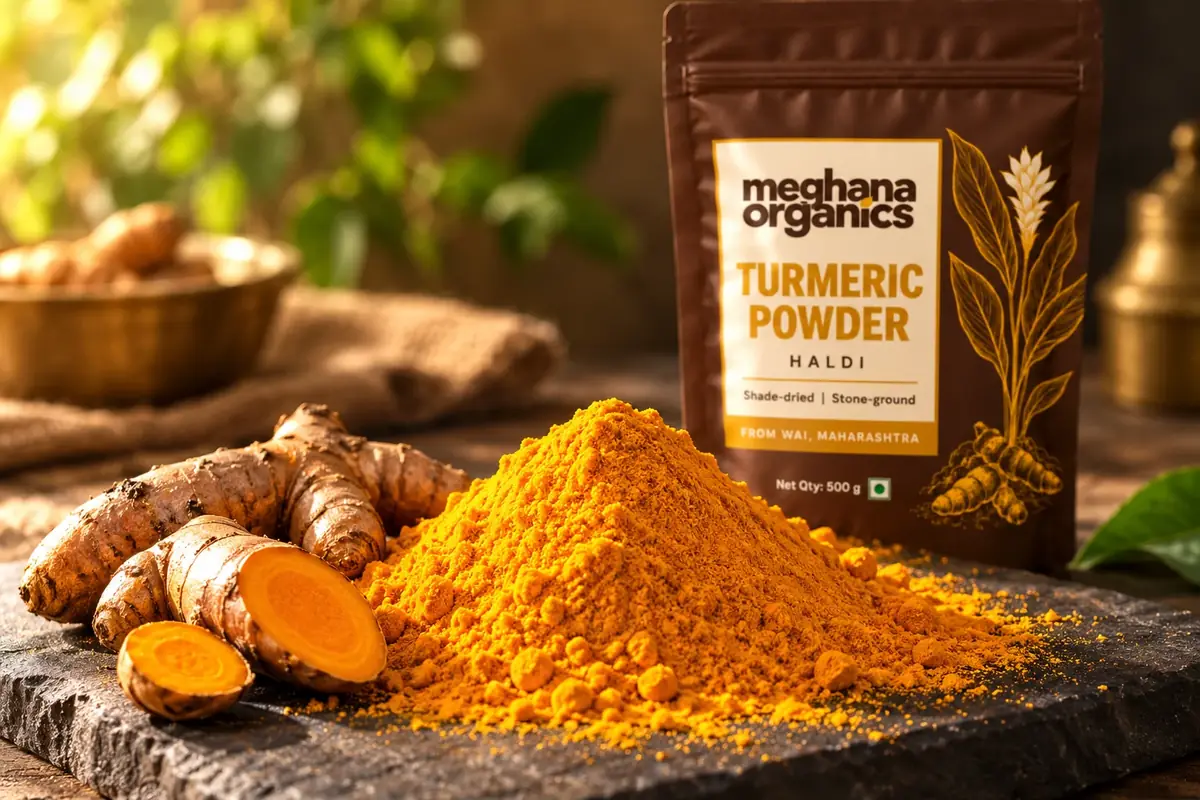
Good turmeric powder (haldi) is a warm yellow with a hint of orange, smells earthy and a little bitter, and comes in a sealed pack with an FSSAI (Food Safety and Standards Authority of India) licence number, a packing date and an expiry date. It names the place it was grown, and if it quotes a curcumin figure, the seller can show a lab report for that batch. The seven checks below take a minute in a shop and a few more online.
The seven checks at a glance
| Check | A good sign | A reason to pause |
|---|---|---|
| Colour | Warm yellow with an orange tint, a little uneven | A neon, lemon-bright yellow |
| Smell | Earthy, warm, slightly bitter | Musty, sour or chemical |
| Label | FSSAI logo and 14-digit number, batch number, packing and expiry dates, the seller's full address | No licence number, no dates, an address that is only a city |
| Origin | A named farm or place, from one source | No place named at all |
| Curcumin | A stated figure with a lab report for the batch | A big number with nothing behind it |
| Pack | Sealed, not see-through, with a storage line | A clear bag, or a scoop from an open sack |
| Price per 100 g | In line with similar packs | Far below the rest |
Colour and smell
Natural haldi is a warm yellow with an orange tint, and it is rarely perfectly even. Do not reach for the brightest packet. A vivid colour is what some sellers add pigment to achieve. A 2026 study of turmeric markets in eastern India reports lead chromate, a yellow pigment, being added to roots to brighten them, and a 2016 paper notes that the dye metanil yellow has been added to turmeric powder to imitate curcumin's colour when the real curcumin content is low.
Rub a pinch between your fingers and smell it. FSSAI's standard says haldi powder must have a characteristic odour and flavour and be free from mustiness or any foreign smell, so a musty, sour or chemical note is a fair reason to put the pack back. Colour and smell are first impressions, not proof: the authors of the 2026 study note that lead levels in turmeric powder cannot be judged by eye.
What the label should show
Look for the FSSAI logo with a 14-digit licence number, the seller's full name and address, a batch number, a packing date, an expiry date, the net weight, the MRP (maximum retail price) and the green vegetarian symbol. Plain haldi is a single-ingredient food, so it needs no ingredient list or nutrition table. If a list is printed and shows anything beyond turmeric, you are holding a blend.
When food is sold online, the label details must be shown to you before you buy, except the batch number and the dates, which you will only see on the pack. Our line-by-line label guide explains each item.
Single origin or a blend
A single-origin pack comes from one named farm or place. A blend mixes lots from several sources. Mixing lots of pure haldi is not the problem, but haldi often passes through many hands. In the eastern India study, the chain ran from farmers to traders who graded and polished the roots, then to millers who ground them (sometimes alongside other spices), and on to wholesalers and kirana (neighbourhood grocery) shops. Each step is another chance to mix lots or add colour.
A seller who can name the farm, the place and the grinder gives you a chain you can ask questions about. Ours is short. The haldi in our Turmeric Powder (Haldi) is grown on our family's farm in Wai, in Satara district, Maharashtra, then shade-dried and stone-ground, with no added colour, fillers or preservatives. The pack says "From Wai, Maharashtra".
What a curcumin claim means
Curcumin is the yellow pigment in haldi and a natural antioxidant (see our antioxidant collection). Labs report it as a percentage of the powder's weight. FSSAI's standard for haldi powder sets a floor of 2.0 percent curcuminoid content on a dry basis, so every compliant pack clears that. Published figures run much higher and much wider: the 2016 paper notes reported values from 0.3 to 8.6 percent, shaped by cultivar (variety), soil and fertiliser. A figure of 6 percent sits in the upper part of that range, which makes it a claim to check, not to take on trust.
Colour does not measure curcumin, because dye can imitate it, so ask for the lab report for the batch. It should show the batch number, the lab's name and its NABL accreditation (NABL is the National Accreditation Board for Testing and Calibration Laboratories), the method, and results for lead and added colours as well as curcumin. India's limit for lead in turmeric is 10 mg per kg.
Our pack states 6%+ curcumin. That is our own figure, and we have not published a lab report yet, so treat it as our claim, not as proof.
Packaging that keeps light and moisture out
Extension guidance from the University of Idaho, Oregon State University and Washington State University says to keep spices in airtight containers in a dry place away from sunlight, so the pack you buy should help you do that. Choose a sealed pouch or tin you cannot see through over a clear bag or a scoop from an open sack, which let in light, air and damp. Look for a storage line such as "store in a cool, dry place": FSSAI requires the label to state storage conditions when the date depends on them. At home, keep the pack closed and away from the stove.
Price per 100 g as a sanity check
Divide the price by the weight in grams and multiply by 100. Ours works out like this:
- 250 g at ₹299 is ₹119.60 per 100 g
- 500 g at ₹549 is ₹109.80 per 100 g
- 1 kg at ₹999 is ₹99.90 per 100 g
When you buy online, add delivery before you compare (ours is ₹80 per order, free from ₹997). Use the figure to spot outliers, not to rank brands. A pack far cheaper per 100 g than similar ones is worth a question about what is in it. A high price proves nothing either: in the 2026 study's 2021 price data from Bihar, lead levels were not strongly linked to price, except at the lowest prices.
If something looks off
Pause before you cook with it. FSSAI publishes simple household checks, and our guide to spotting fake turmeric powder walks through the water test and why it is a rough screen, not proof. If you suspect added dye or lead, our metanil yellow guide explains how to report a pack and where to get a sample tested.
Keep to cooking amounts: haldi is a food, not a medicine. If you are pregnant or nursing, take regular medication or have a health condition, check with your doctor before going beyond them.
Sources
- FSSAI, Food Products Standards and Food Additives Regulations, chapter 2.9: the standard for turmeric (haldi) powder
- FSSAI, Labelling and Display Regulations, 2020 (compendium, July 2022)
- Dhakal et al., Evaluation of turmeric powder adulterated with metanil yellow, Foods (2016)
- Forsyth et al., Lead chromate in turmeric across eastern India, npj Science of Food (2026)
- University of Idaho, Oregon State University and Washington State University Extension, Storing Food for Safety and Quality (PNW 612)
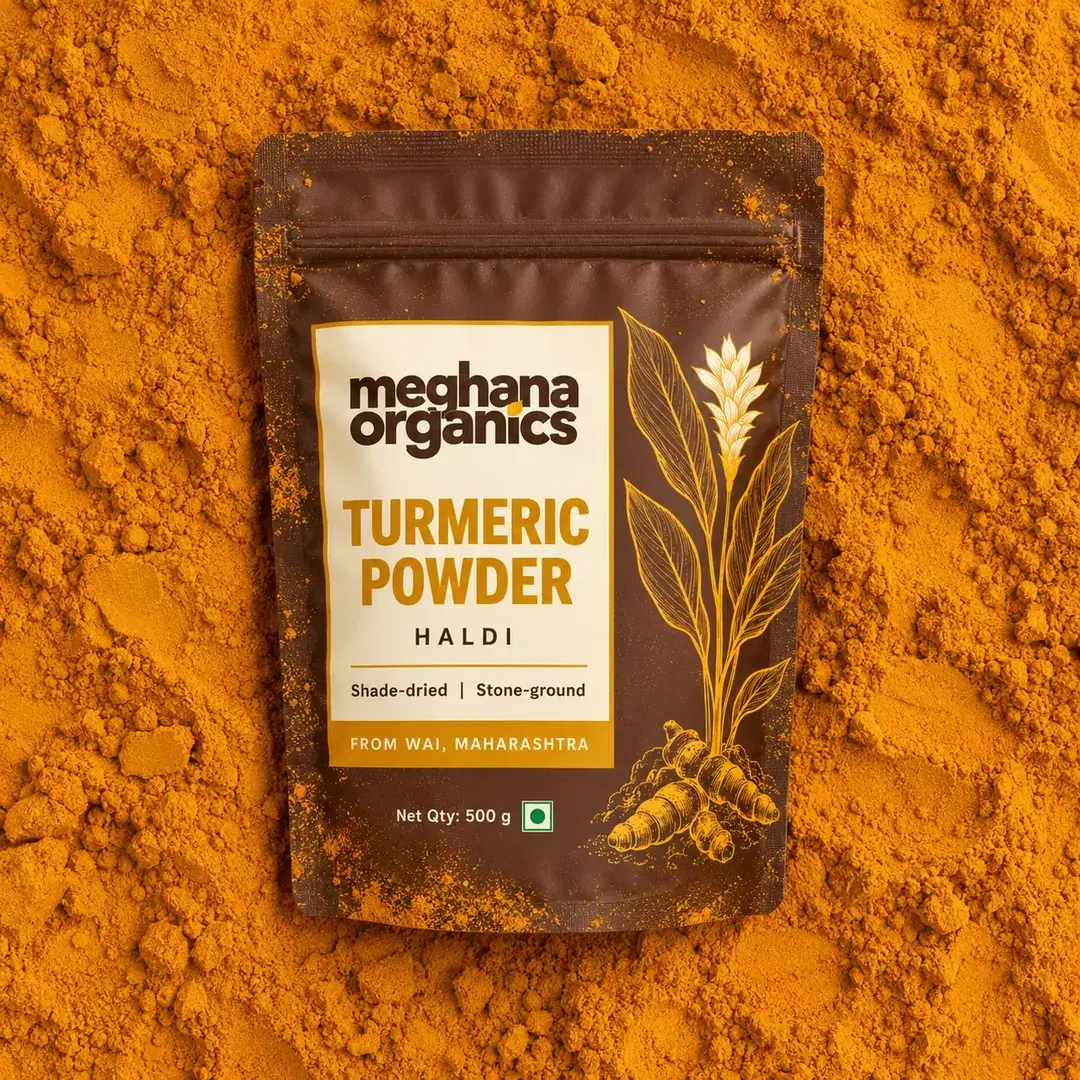
Turmeric Powder (Haldi)
From our family farm in Wai, Maharashtra. Shade-dried and stone-ground, with nothing added. 250g ₹299, 500g ₹549, 1kg ₹999.
Written by Meghana Organics Team
We are the family behind Meghana Organics. Our haldi grows on our farm in Wai, Maharashtra, and we cook with it every day. Here we write about how it is made, how to choose and store it, and how we use it.