Metanil yellow is a synthetic yellow dye that is not permitted in food in India. It has been added to turmeric powder (haldi) to imitate the colour of curcumin, the pigment that makes haldi yellow. FSSAI (the Food Safety and Standards Authority of India) publishes simple household checks for coloured haldi, but they are rough screens, not proof: a laboratory is the only way to be sure, and a suspect pack should be reported.
What metanil yellow is
Metanil yellow is an azo dye, a family of synthetic colours. A 2016 paper in Foods describes it being added to turmeric powder to mimic curcumin's appearance when the real curcumin content is low. FSSAI's standard for haldi powder says it must be free from any added colouring matter, including lead chromate, so any added dye makes haldi powder non-compliant, even a colour that is allowed in some other foods. Metanil yellow is not on FSSAI's short list of permitted synthetic food colours, each of which comes with a maximum level for the foods it may be used in.
That 2016 paper also cites rat studies linking long-term intake of metanil yellow to effects on the nervous system and the liver. Those are animal studies, not measurements of what one meal does to a person, and they are no reason to panic over a single curry. They are a reason not to eat it knowingly, and to report it when you find it.
Lead chromate, the other added colour to know about
Lead chromate is a bright yellow pigment that contains lead. FSSAI's standard requires haldi to be free of it. There is no known safe level of lead exposure, and children are especially vulnerable. In a 2026 study of 503 turmeric samples from retail and wholesale markets in 34 cities across five eastern Indian states, 30 percent had more lead than India's limit of 10 mg per kg, with the highest levels in Bihar. The authors report that lead chromate was added mainly when whole roots were polished, to brighten them and to fill insect damage. Double-polished roots and loose powder were much more likely to exceed the limit than single-polished roots, with more than four times the odds.
That is a study of particular markets, and it does not say all haldi is affected. It does show where to be careful: ask where the haldi was grown and whether anything is added during polishing and grinding. A lab report that covers lead is worth asking for.
Why colour gets added to haldi
Buyers judge haldi by colour, and a few traders use that to sell a weaker product. Interviews in the 2026 study describe additions at three stages: boiling, polishing and grinding. Lead chromate was reported mainly at polishing. It was also used to fill insect damage on roots stored for months, so traders said it was more common late in the year. Interviewees and sample tests also pointed to other additions, including alum, an iron oxide compound and food colours such as tartrazine. The authors add that you cannot tell by looking at a powder whether its lead level is high, so the shade of the powder tells you little. The source, the label and a lab report tell you more.
Checks you can do at home
FSSAI's DART booklet (Detect Adulteration with Rapid Test) lists quick household tests, written to raise awareness among consumers. Three apply to haldi, and all of them need only a glass of water.
| DART test | What you do | Natural haldi, per FSSAI | Adulterated, per FSSAI |
|---|---|---|---|
| Test 14: lead chromate in whole haldi (the dried fingers) | Put a small amount of whole dried haldi in a clear glass of water | Leaves no colour | Looks bright and leaves colour in the water at once |
| Test 15: artificial colour in haldi powder | Add a teaspoon of powder to a glass of water | Leaves a light yellow while settling | Leaves a strong yellow while settling |
| Test 16: sawdust and bran in powdered spices | Sprinkle the powder on the surface of water | Nothing floats on the surface | Sawdust or bran floats |
Treat these as rough screens. They cannot tell you which dye is present or how much, and a clear result does not prove a pack is clean. Our guide to spotting fake turmeric powder goes through them in more detail. Some websites describe tests that add strong acid to haldi. Skip those: concentrated acid is corrosive and can burn skin, and a colour change in a kitchen proves nothing. Confirmation belongs in a laboratory.
If you suspect adulteration
- Stop using the pack. Keep it sealed in a bag with the bill or order page, photograph the front and back, and note the batch number and the FSSAI licence number.
- Report it. FSSAI's Food Safety Connect app takes complaints about food safety, and FSSAI says complaints lodged through the app are routed automatically to the authority responsible for your area. FSSAI's FoSCoS portal (foscos.fssai.gov.in) is the web route. Give the licence number, and the web address of the listing if you bought online.
- Get a sample tested if you want proof. Use an NABL-accredited food testing laboratory (NABL is the National Accreditation Board for Testing and Calibration Laboratories); FSSAI publishes a list of those it has notified. Ask for added colours, including metanil yellow, and for lead, and check on the NABL website that the lab's scope covers those tests on spices.
- Tell the seller. A reputable one will want the batch number.
If a child or someone who is pregnant has been eating a suspect powder regularly, speak to a doctor. Lead exposure is checked with a blood test.
Buying with fewer worries
Buy sealed, labelled packs with a licence number, from a seller who names where the haldi was grown, and keep the batch number until the pack is finished. Our buying checklist and label guide turn this into a few quick checks. Our Turmeric Powder (Haldi) is grown on our family's farm in Wai, then shade-dried and stone-ground, with no added colour, fillers or preservatives. We have not published a lab report yet, so apply the same checks to our pack as to any other.
Sources
- FSSAI (Eat Right India), DART: Detect Adulteration with Rapid Test, spices tests 14 to 16
- FSSAI, Food Products Standards and Food Additives Regulations, chapter 2.9: the standard for turmeric (haldi) powder
- Dhakal et al., Evaluation of turmeric powder adulterated with metanil yellow, Foods (2016)
- Forsyth et al., Lead chromate in turmeric across eastern India, npj Science of Food (2026)
- FSSAI, press release on the Food Safety Connect app (1 August 2025)
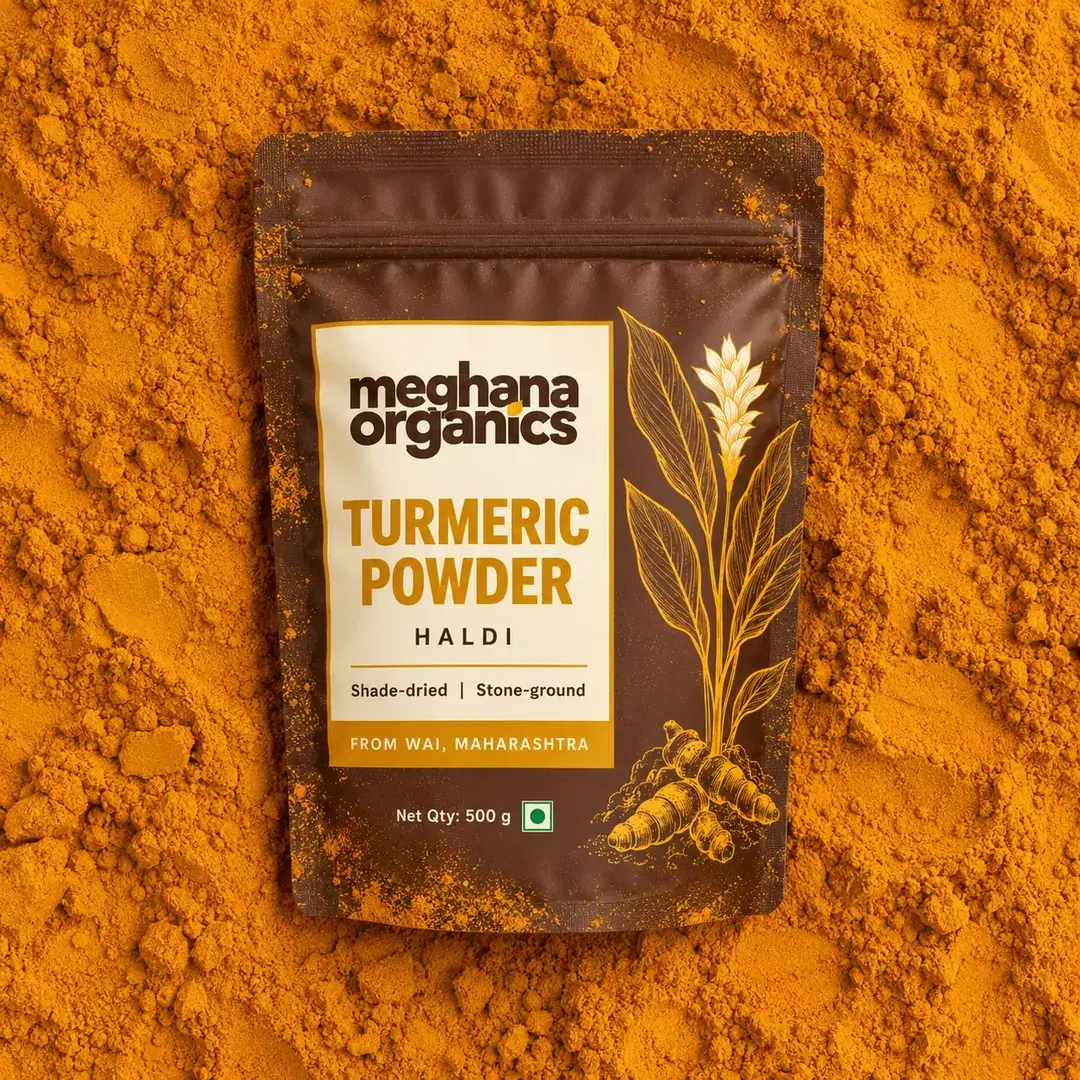
Turmeric Powder (Haldi)
From our family farm in Wai, Maharashtra. Shade-dried and stone-ground, with nothing added. 250g ₹299, 500g ₹549, 1kg ₹999.
Written by Meghana Organics Team
We are the family behind Meghana Organics. Our haldi grows on our farm in Wai, Maharashtra, and we cook with it every day. Here we write about how it is made, how to choose and store it, and how we use it.