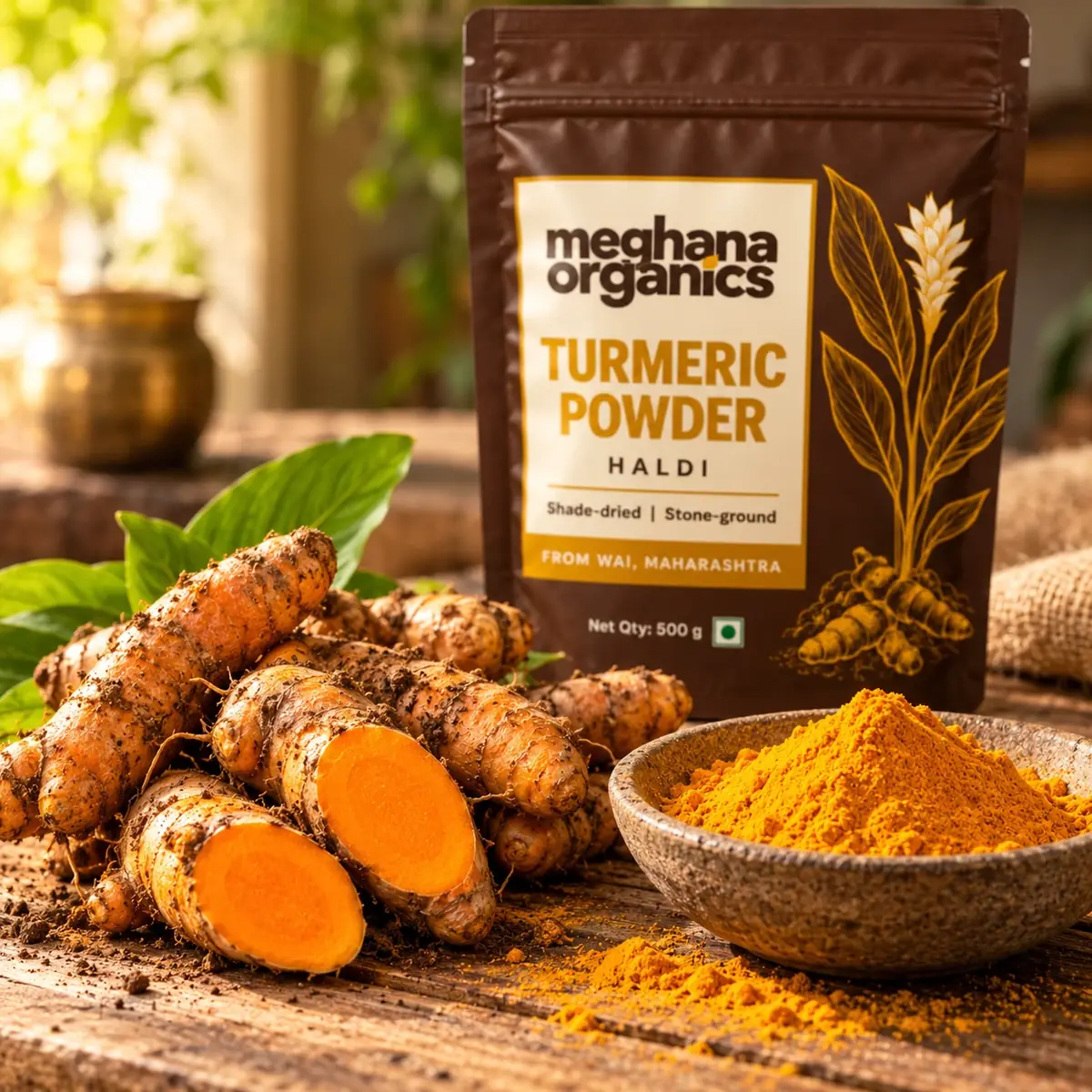
Turmeric powder is made from the underground stems, called rhizomes, of the turmeric plant. After harvest they are cleaned, boiled until soft, dried until hard, polished, and then ground and sieved into a fine powder. India's Spices Board describes the spice itself as the boiled, dried, cleaned and polished rhizomes of Curcuma longa. The steps below cover each of those stages and what comes after.
The steps come from Indian agricultural sources, so they describe the usual process, not one farm. Near the end is a short section on how our own haldi from Wai is made.
Harvesting the rhizomes
Turmeric is ready to dig seven to nine months after planting for most varieties, and up to ten months for the longest-duration ones. In India the crop is generally harvested between January and March. Mature plants show it: the leaves turn yellowish or light brown and dry out.
Some farms harvest by hand. The land is ploughed, the clumps are lifted carefully with a spade and the rhizomes are picked out and gathered. Others use a tractor with a turmeric harvester attached. Either way, the aim is to lift the whole plant without cutting or bruising the rhizomes.
Cleaning and separating
The harvested rhizomes are cleaned of mud and other loose material. Each plant gives two kinds: the mother rhizome, also called the bulb, which is the large central piece, and the fingers, which are the side branches. They are separated and handled apart, because the mother rhizomes take longer to cook. The mothers are also the preferred planting material for the following year.
Boiling
Within two to four days of harvest, the fresh rhizomes are boiled in water. Traditionally this is done in a galvanised iron vessel. One text recommends perforated containers and small batches of 50 to 75 kg. An ICAR article gives 45 to 60 minutes for fingers and about 90 minutes for mother rhizomes. When large quantities are handled, the rhizomes are steamed in a boiler instead.
Boiling is judged by sight and touch, not only by the clock. Froth forms and white fumes rise with a characteristic smell. A pointed stick goes into the rhizome with only slight pressure, the rhizome is soft enough to break between finger and thumb, and the inside is yellow rather than red. Over-cooking spoils the colour, and under-cooking leaves the rhizome brittle.
Boiling has three jobs: it shortens the drying time, spreads the colour evenly through the rhizome and sterilises it before it dries.
Drying
The boiled rhizomes are spread out to dry. In the usual method they dry in the sun for about 12 to 14 days, in a thin layer on bamboo mats or a drying floor. Some processors use mechanical dryers instead. The Kerala Agricultural University portal gives 60°C as the maximum for a bright-coloured product, and another text says hotter drying gives a darker one.
The rhizomes are done when they are hard, snap cleanly and are down to about 10% moisture. Drying also shrinks them a great deal. Dry turmeric weighs only 19 to 23% of the fresh weight, so it takes about 4 to 5 kg of fresh rhizomes to make 1 kg of dry ones.
Polishing
Dried rhizomes are rough and dull, with scales and the stubs of roots on the surface. Polishing rubs these off and improves the appearance. It is done by hand, by shaking the rhizomes in a gunny bag with stones, or in a rotating drum lined with mesh, where the rhizomes rub against the mesh and against each other.
Colour can also be added at this stage. In some places the rhizomes are sprinkled with a solution of ground turmeric in water during the final polish, to give them a good colour.
Grading
The rhizomes are sorted into fingers, bulbs and splits. Fingers are 2 to 8 cm long and 1 to 2 cm wide. Bulbs are the mother rhizomes, and splits are bulbs cut into halves or quarters before boiling. Bulbs and splits are more fibrous than fingers, so fingers are easier to grind.
Quality is judged by clean, smooth skin, an even colour outside and in, and a clean snap when the rhizome is broken, as described in the Agmark standards of the Ministry of Agriculture.
Grinding, sieving and packing
The rhizomes are cut and crushed into small pieces, ground, and then sifted through several screens to a fine powder, around 60 to 80 mesh. Grinding makes heat. One spice-technology text notes that, depending on the type of mill and the speed of crushing, the spice can heat up and lose volatile oils. Cryogenic milling under liquid nitrogen avoids this, but it is expensive and not widespread.
Curcumin, the pigment that makes turmeric yellow, slowly fades with light, and to a lesser extent with heat and air. That is why powder is packed in moisture-proof, light-protective packaging, and why storage at home matters too. Our guide to storing turmeric covers it.
How ours differs
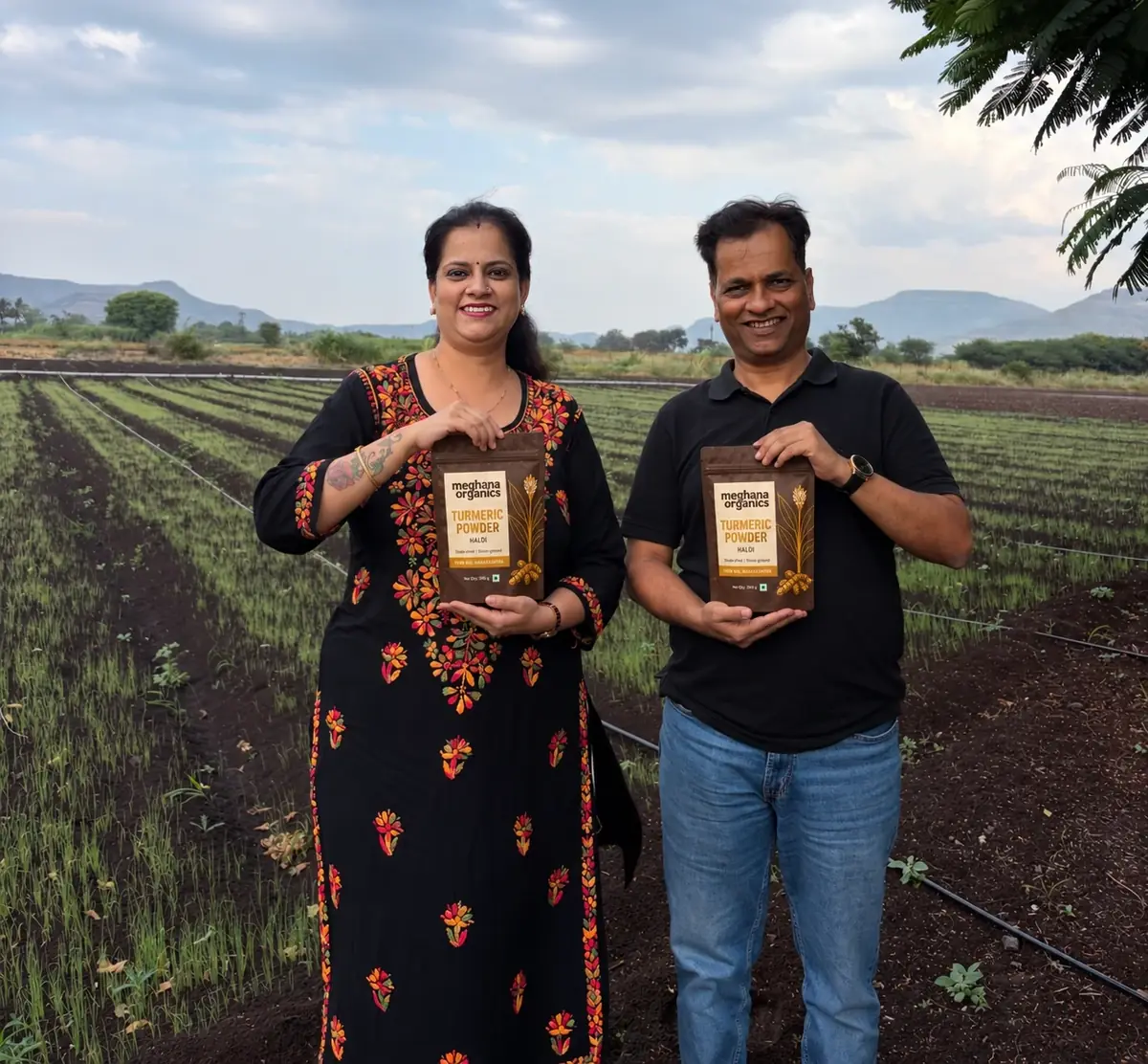
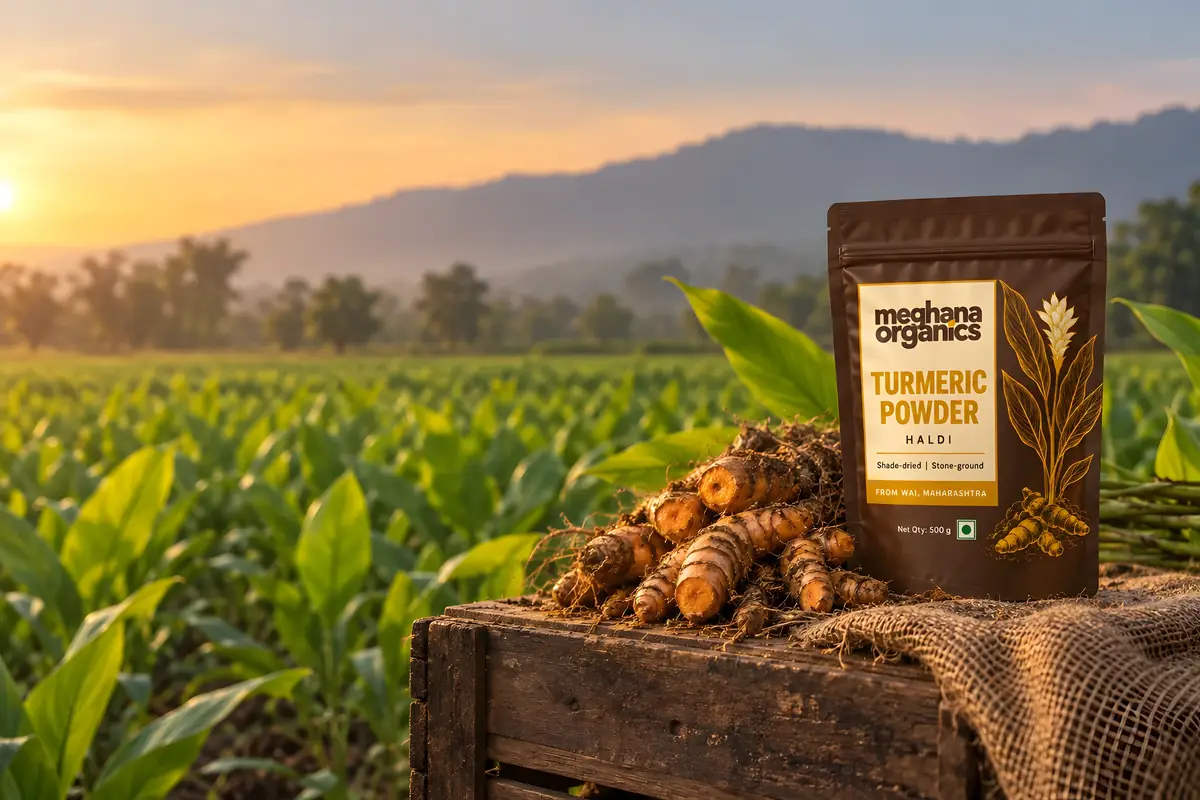
Our haldi comes from our family's farm in Wai, in Satara district, Maharashtra. This is how we describe the steps. The roots are dug up on our farm. The fresh roots are boiled before drying, the traditional way. They then dry slowly in the shade, out of direct sun, with no drying machines. The dried roots are stone-ground at low temperatures. Nothing is added: no colour, fillers or preservatives.
Set against the usual process above:
- Boiling: the fresh roots are boiled before drying, as in the usual process.
- Drying: in the shade, with no drying machines, rather than in the sun or in a mechanical dryer.
- Grinding: stone-ground at low temperatures, to keep down the heat that grinding can create.
- Nothing added: no added colour, so no colour wash of the kind some processors use, and no fillers or preservatives.
The family will add photos of each step to this guide. You can read more about the farm in Wai, where our turmeric grows, and see the pack and its sizes on the Turmeric Powder (Haldi) page.
When you are choosing any pack, how to buy good turmeric powder in India lists what to look for on the label and in the powder.
Sources
- ICAR-Indian Institute of Spices Research (Alfiya P V, Jayashree E and Anees K), "Turmeric: golden spice to value-added treasure", Indian Horticulture, 2025
- Prof. D. C. Saxena, Technology of Spices and Condiments, chapter 28 on turmeric (INFLIBNET e-text)
- Kerala Agricultural University, KAU Agri-Infotech Portal: Turmeric (Curcuma longa)
- Spices Board India: Turmeric (spice catalogue)
Turmeric Powder (Haldi)
From our family farm in Wai, Maharashtra. Shade-dried and stone-ground, with nothing added. 250g ₹299, 500g ₹549, 1kg ₹999.
Written by Meghana Organics Team
We are the family behind Meghana Organics. Our haldi grows on our farm in Wai, Maharashtra, and we cook with it every day. Here we write about how it is made, how to choose and store it, and how we use it.