India grows many named turmerics, usually named for the district or market they come from: Alleppey in Kerala, Erode and Salem in Tamil Nadu, Sangli and Waigaon in Maharashtra, Kandhamal in Odisha and Lakadong in Meghalaya. The curcumin figures reported for them run from about 2.5% to 12%, and the sources do not always agree. There is no single best variety, and a name on a pack is not proof of what is inside it.
Indian turmerics at a glance
Five of the names below hold a GI (geographical indication) tag. The dates are the certificate dates in the Spices Board's list of spice GIs, as of 15 September 2026, and "none listed" means the name is not on that list. The curcumin figures are quoted as each source gives them. Most sources do not say when or how the samples were tested.
| Turmeric | Grown in | GI tag | Curcumin as reported |
|---|---|---|---|
| Lakadong | East and West Jaintia Hills, Meghalaya | Yes, 30 March 2024 | 6.8% to 7.5% (Down To Earth, 2021); 7% to 12% (Meghalaya Farmers' Commission, 2024) |
| Waigaon | Wardha district, Maharashtra | Yes, 3 June 2016 | 6.12% (Down To Earth) |
| Alleppey finger | Kerala | None listed | 5.5% for IISR Alleppey Supreme, a selection from Alleppey finger turmeric (ICAR-IISR) |
| Salem | Salem, Tamil Nadu | None listed | 4.75% for Salem local (TNAU) |
| Erode (Erode Manjal) | Erode, Tamil Nadu | Yes, 6 March 2019 | 2.5% to 4.5% (Down To Earth); 3.9% for Erode local (TNAU) |
| Kandhamal Haladi | Kandhamal district, Odisha | Yes, 1 April 2019 | 3.2% to 4.2% (Down To Earth) |
| Sangli (Rajapuri) | Sangli district, Maharashtra | Yes, 7 November 2018 | 3.45% (Down To Earth) |
A sixth GI turmeric, Vasmat Haldi (certificate dated 30 March 2024), is not in the table because we found no curcumin figure for it. Sangli turmeric became known as Rajapuri through exports from the port of Rajapur, according to Wikipedia.
Down To Earth printed its figures in a 2021 chart of GI turmerics and does not say how they were measured. The Salem and Erode figures are for the local types described by Tamil Nadu Agricultural University (TNAU). The 7% to 12% for Lakadong is from the Meghalaya Farmers' (Empowerment) Commission's 2024 press release on its GI tag. Alleppey Supreme is a variety that ICAR-IISR selected from Alleppey finger turmeric, so 5.5% is that variety's figure, not an average for everything sold as Alleppey.
Most names in the table are local types named for a place. Bred varieties have their own figures: TNAU's list gives CO 1 at 3.2% and BSR 3 at 4.8%. Both kinds are called varieties in everyday talk, which is part of why comparing them is hard.
Quick answers
- Highest reported curcumin: Lakadong, at 6.8% to 12% depending on the source. Among the GI turmerics in the Down To Earth chart, Waigaon comes next at 6.12%.
- GI-tagged turmerics: six are on the Spices Board's list: Waigaon, Sangli, Erode, Kandhamal, Vasmat and Lakadong.
- Alleppey and Salem: neither name is on the Spices Board's list of spice GIs.
Why the numbers differ
Curcumin, the main yellow pigment in turmeric, is not fixed by variety alone. A study of 119 samples from eight agro-climatic regions of Odisha found curcumin ranging from 0.4% to 7.2%, and found that minimum relative humidity, altitude, soil nitrogen and soil pH had the greater effect (Frontiers in Plant Science, 2016). Even within one plant the amount differs: an ICAR trial in Meghalaya found that fresh mother rhizomes carried 15% to 38% more curcumin than the fingers (Indian Journal of Agricultural Sciences, 2017).
Processing and storage matter too. In the same trial, turning fresh rhizomes into dry powder cut curcumin by 2% to 8%, and heat, light and air keep reducing it after that.
So read a figure in the table as a typical range for that name, not a promise about the pack in your hand. Our guide to curcumin in turmeric powder explains what the percentage means in the kitchen.
What a GI tag does and does not tell you
A geographical indication is a sign used on products that come from a specific place and have qualities or a reputation that are due to that origin, as WIPO puts it. The right holders, which in India are often a farmers' group or a state department, can stop others using the name on produce that does not meet the agreed standards. It is a statement about origin, not a lab report for the pack you buy.
The table shows the gap. Waigaon and Sangli are both GI-tagged, yet the Down To Earth chart puts them at 6.12% and 3.45%. The Meghalaya Farmers' Commission's own press release says that turmeric from other regions has been wrongly sold as Lakadong. A protected name is a good start, but it is not proof.
How to choose
- Ask for the batch report. A curcumin figure means more with the date, the lab and the method beside it.
- Look for the place, not only the name. A pack that says where the turmeric was grown tells you more than a variety name on its own.
- Remember that curcumin is one measure. Freshness, how the powder was stored and what is in the pack, ideally only turmeric, matter as well.
Our guide to buying good turmeric powder in India goes through the label and the powder step by step.
Where our haldi fits
Our haldi is grown on our family's farm in Wai, in Satara district, in western Maharashtra. Wai is not Waigaon: Waigaon is a village in Wardha district, in the east of the state, and Waigaon turmeric is a GI name of its own. Ours is not sold under any GI name and we are not claiming a variety, so please do not read it as Alleppey, Erode, Salem, Sangli, Lakadong or any other name in the table. You can read about the place in Wai, where our turmeric grows.
We say 6%+ curcumin. That is the owner's figure, and there is no published lab report for it yet, so read it the way you would read any figure in this article: as a claim to ask about. The sizes and prices are on the Turmeric Powder (Haldi) page.
Sources
- Spices Board India: List of Geographical Indication (GI) Tags Registered for Spices (as of 15 September 2026)
- Down To Earth, "Turmeric territory" chart, 16-31 October 2021, page 29
- Tamil Nadu Agricultural University (TNAU) Agritech Portal: Turmeric varieties
- Meghalaya Farmers' (Empowerment) Commission, press release on the Lakadong Turmeric GI tag, 3 April 2024
- ICAR-Indian Institute of Spices Research: IISR Alleppey Supreme
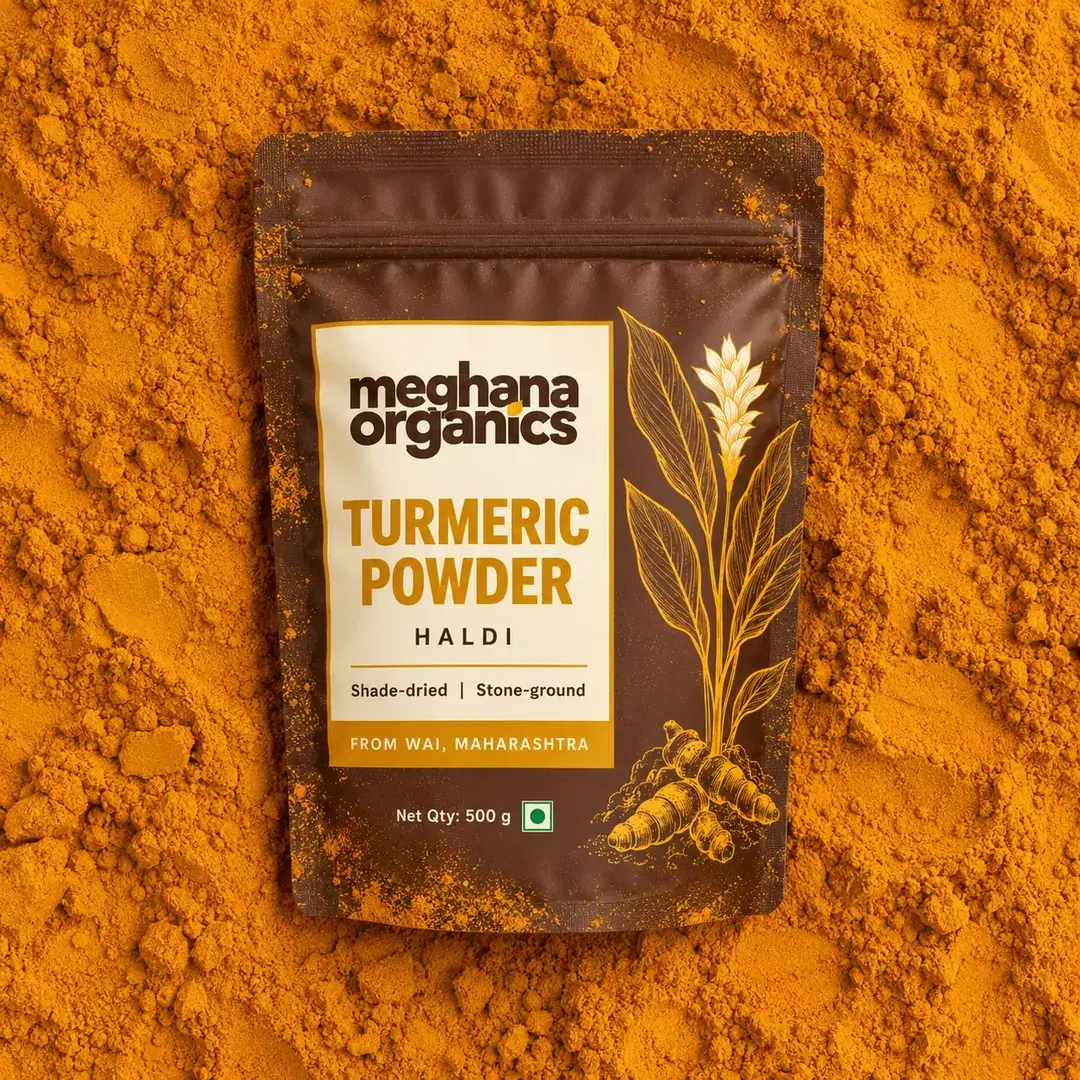
Turmeric Powder (Haldi)
From our family farm in Wai, Maharashtra. Shade-dried and stone-ground, with nothing added. 250g ₹299, 500g ₹549, 1kg ₹999.
Written by Meghana Organics Team
We are the family behind Meghana Organics. Our haldi grows on our farm in Wai, Maharashtra, and we cook with it every day. Here we write about how it is made, how to choose and store it, and how we use it.