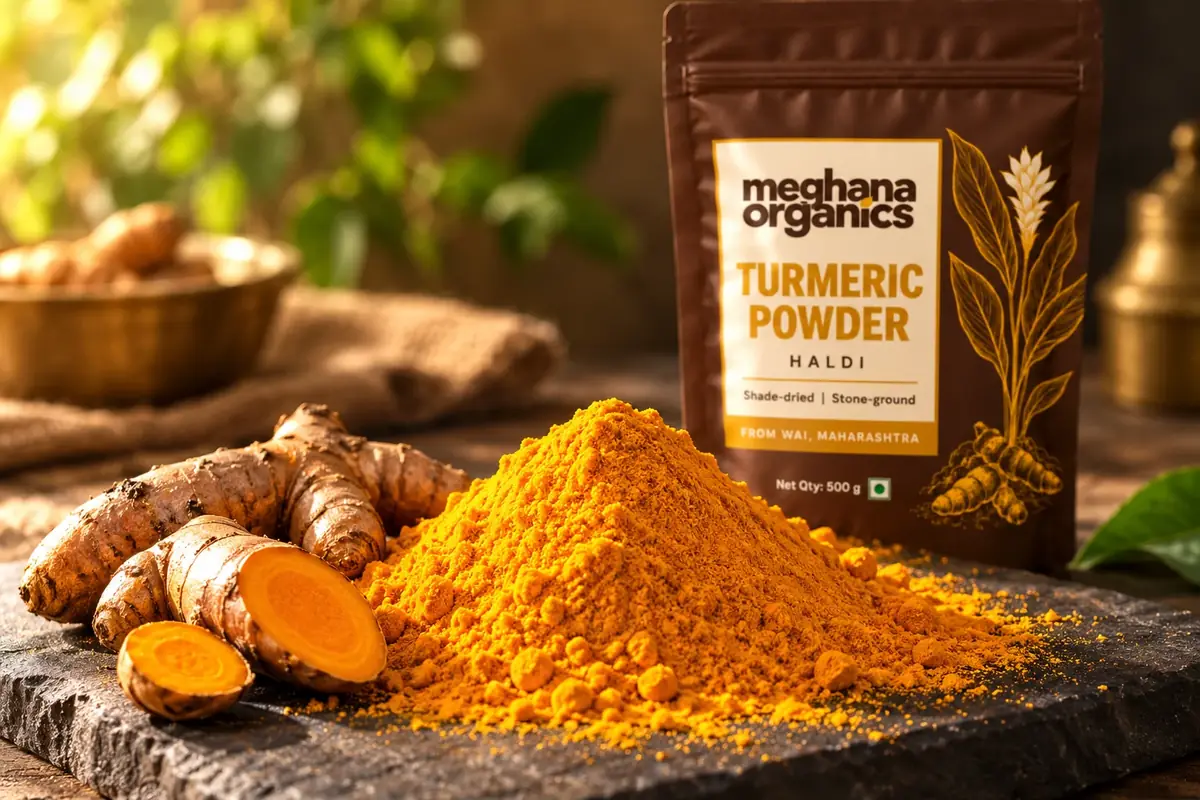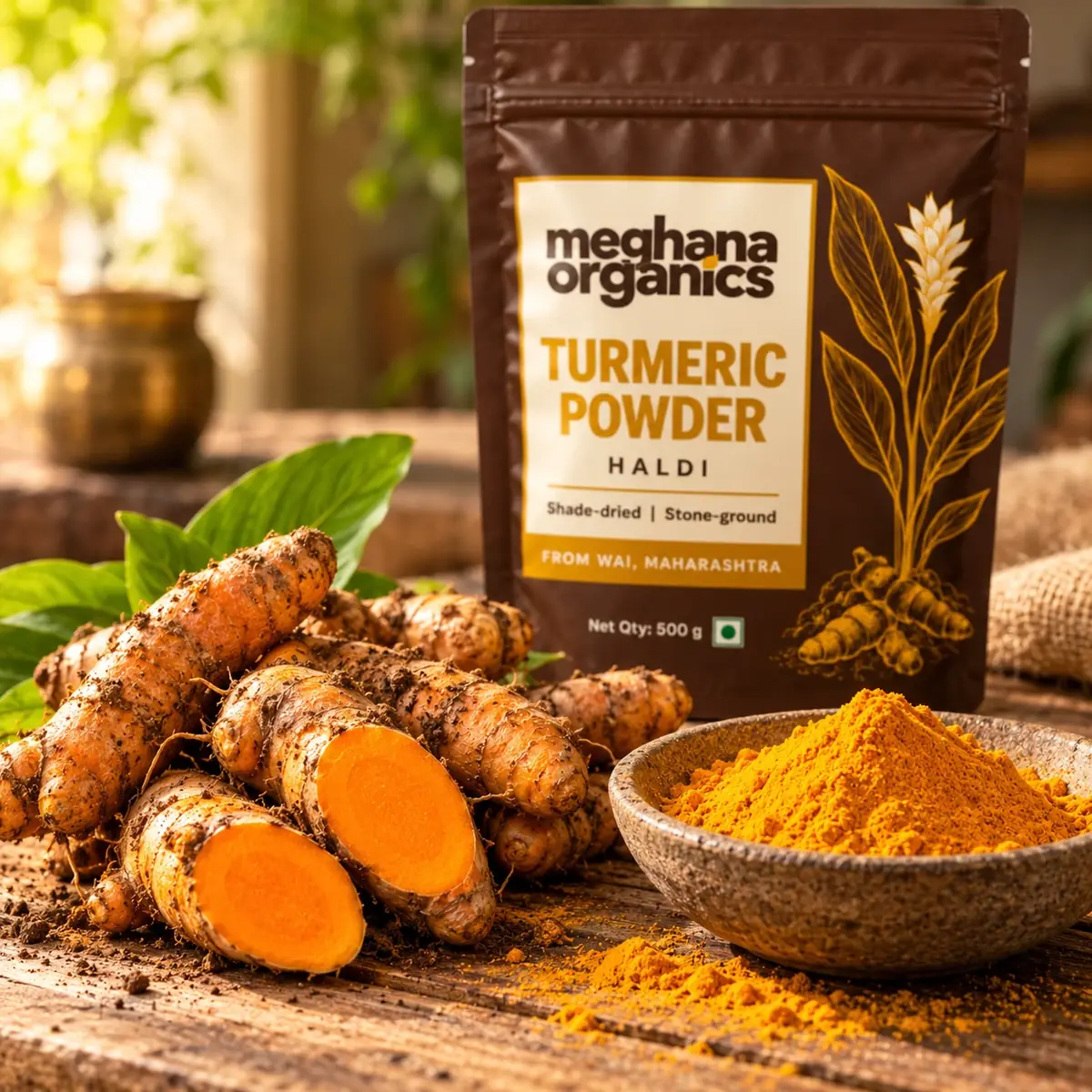
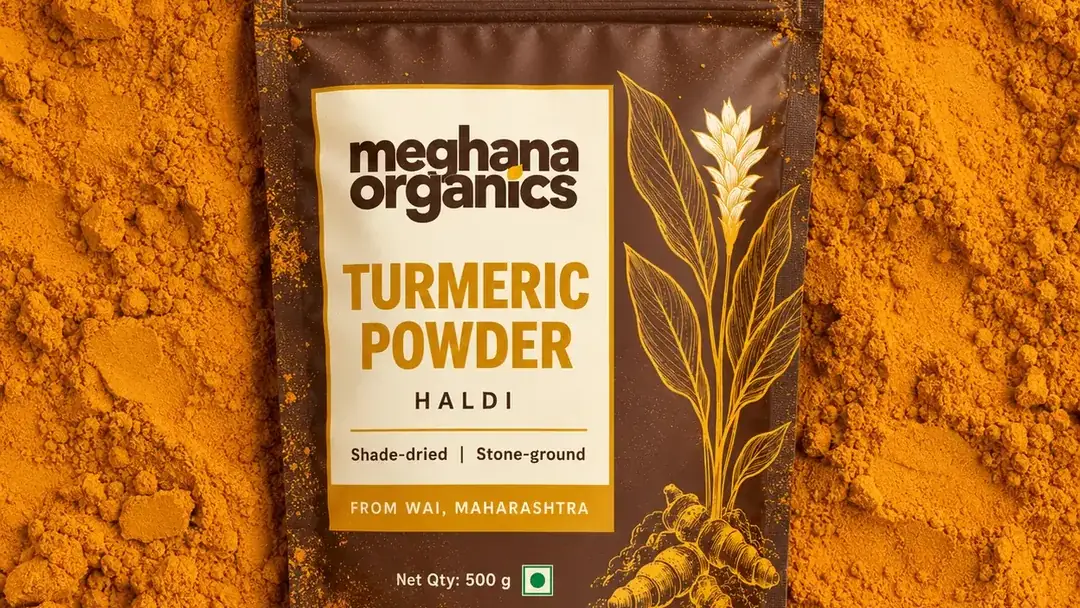
Under the Food Safety and Standards (Labelling and Display) Regulations, 2020, a retail pack of turmeric powder (haldi) in India has to carry the product name, the FSSAI (Food Safety and Standards Authority of India) logo with a 14-digit licence number, a batch number, a packing date, an expiry date, the brand owner's name and address, and the green vegetarian symbol. The Legal Metrology (Packaged Commodities) Rules, 2011 add the net quantity, the MRP (maximum retail price) and customer care details. Plain haldi is a single-ingredient spice, so it can leave out the ingredient list and the nutrition table.
The label, line by line
| Label item | What it tells you | What to watch for |
|---|---|---|
| Product name, on the front | What is in the pack. The name must show the true nature of the food, and a brand name may be added to it | "Turmeric powder" or "haldi powder" for plain haldi. A name such as "haldi masala" or "turmeric blend" means something else |
| Ingredients | Single-ingredient foods need no list. A printed list runs from the largest ingredient by weight downwards | Anything beyond turmeric, such as starch, flour or colour. Haldi powder may not contain any added colour (see the metanil yellow guide) |
| Net quantity | The weight of the contents, in grams or kilograms | Compare packs by price per 100 g, not by price alone |
| FSSAI logo and licence number | The brand owner's licence (or registration) with FSSAI, 14 digits. If a different business makes or packs it, that business's number is shown too | No number, a shorter number, or "FSSAI approved" with no digits. FSSAI's Food Safety Connect app lets you look up basic details of licensed and registered food businesses |
| Batch or lot number | Lets the maker trace this batch if there is a problem | A missing or unreadable number |
| Date of manufacture or packing | When the haldi was made or packed, printed as a month and year or as a full date | No date at all |
| Expiry or use-by date | FSSAI requires an expiry or use-by date, and a pack may add "best before". After a best-before date the food may still be safe, but its quality may have faded. After a use-by date it may not be safe | A missing date. A storage line such as "store in a cool, dry place" must be there if the date depends on it |
| MRP | The most you can be charged, inclusive of all taxes | A lower selling price is fine; a higher one is not allowed |
| Brand owner's name and address | Who answers for the pack, introduced by words such as "Manufactured by", "Marketed by" or "Packed & Marketed by" | A full postal address, not only a city. It tells you who sells the pack, not where the haldi was grown |
| Customer care details | A name, address, phone number and email for complaints | A number that does not ring or an email that bounces. Test it before you need it |
| Vegetarian symbol | A green dot in a square near the product name on the front marks plant-based food. A brown triangle marks non-vegetarian food | No symbol, or a brown triangle on plain haldi |
| Country of origin | Imported food must show it, with the importer's name and address | Indian-grown haldi need not say where it was grown, so look for an origin line or ask the seller |
What a haldi pack can leave out
FSSAI exempts a herb, a spice or a mixture of them from the nutrition table, so its absence on plain haldi is normal. Very small packs, with a surface area of up to 100 square centimetres, such as a sample sachet, may also leave out the batch number and the licence number and logo. Those details then go on the multi-unit pack the sachets come in. Everything on a label must be clear, readable and permanent, in English or Hindi in Devanagari script, and other languages can be added.
Buying online
When food is sold online or by another direct selling route, FSSAI requires the mandatory label details to be given to the buyer before the sale. The exceptions are the batch number and the dates, which appear only on the pack. Screenshot the listing, and when the pack arrives, check that it matches.
AGMARK is an optional grade mark
AGMARK is a government quality-certification mark for farm produce, issued through the Directorate of Marketing and Inspection. FSSAI makes it compulsory only for a short list of foods. A 2018 FSSAI notice listed seven, among them blended edible oil, fat spread, Kangra tea and light black pepper. Turmeric was not on it, so for haldi AGMARK is optional: a pack without it is not breaking a rule, and a pack with it has been graded against a government standard for that product. AGMARK is about grade, so it says nothing about how or where the crop was grown.
What the Jaivik Bharat logo means
Jaivik Bharat (roughly "Bio India") is the green FSSAI logo for food certified under one of India's two national certification systems: NPOP, a government programme that uses accredited certifiers, or PGS-India (Participatory Guarantee System for India), an agriculture ministry scheme that relies on producers, consumers and others taking part rather than on outside certifiers. FSSAI's labelling rules say every package of certified food of this kind must carry the logo. Its 2017 regulations for this food go further: it may be offered for sale only if it follows NPOP or PGS-India, with a narrow exemption for small original producers who sell directly to the buyer.
The practical rule is simple. If a pack claims to be grown and certified this way, in Hindi as "jaivik" or in English, but shows neither the logo nor the name of a certifier or scheme, you cannot check the claim from the pack, so do not pay extra for it. Our pack does not carry the Jaivik Bharat logo. Meghana Organics is our brand name, and we make no certified-farming claim for our haldi.
If a label looks wrong
A label shows what the brand owner says, not what is in the pack. For checks on the powder itself, see our guide to spotting fake turmeric powder. If the label itself breaks the rules, photograph the front and back, note the batch and licence numbers (and the web address, if you bought online), and report it through FSSAI's Food Safety Connect app, which also takes reports of misleading claims on food products.
Our Turmeric Powder (Haldi) comes in 250 g, 500 g and 1 kg packs, and the pack says "From Wai, Maharashtra". To compare it with other packs, use our buying checklist.
Sources
- FSSAI, Labelling and Display Regulations, 2020 (compendium, July 2022)
- Department of Consumer Affairs, Legal Metrology (Packaged Commodities) Rules, 2011, with all amendments
- FSSAI, Food Safety and Standards (Organic Foods) Regulations, 2017 (compendium, October 2021)
- FSSAI, Mandatory Certification under AGMARK (notice, January 2018)
- FSSAI, press release on the Food Safety Connect app (1 August 2025)
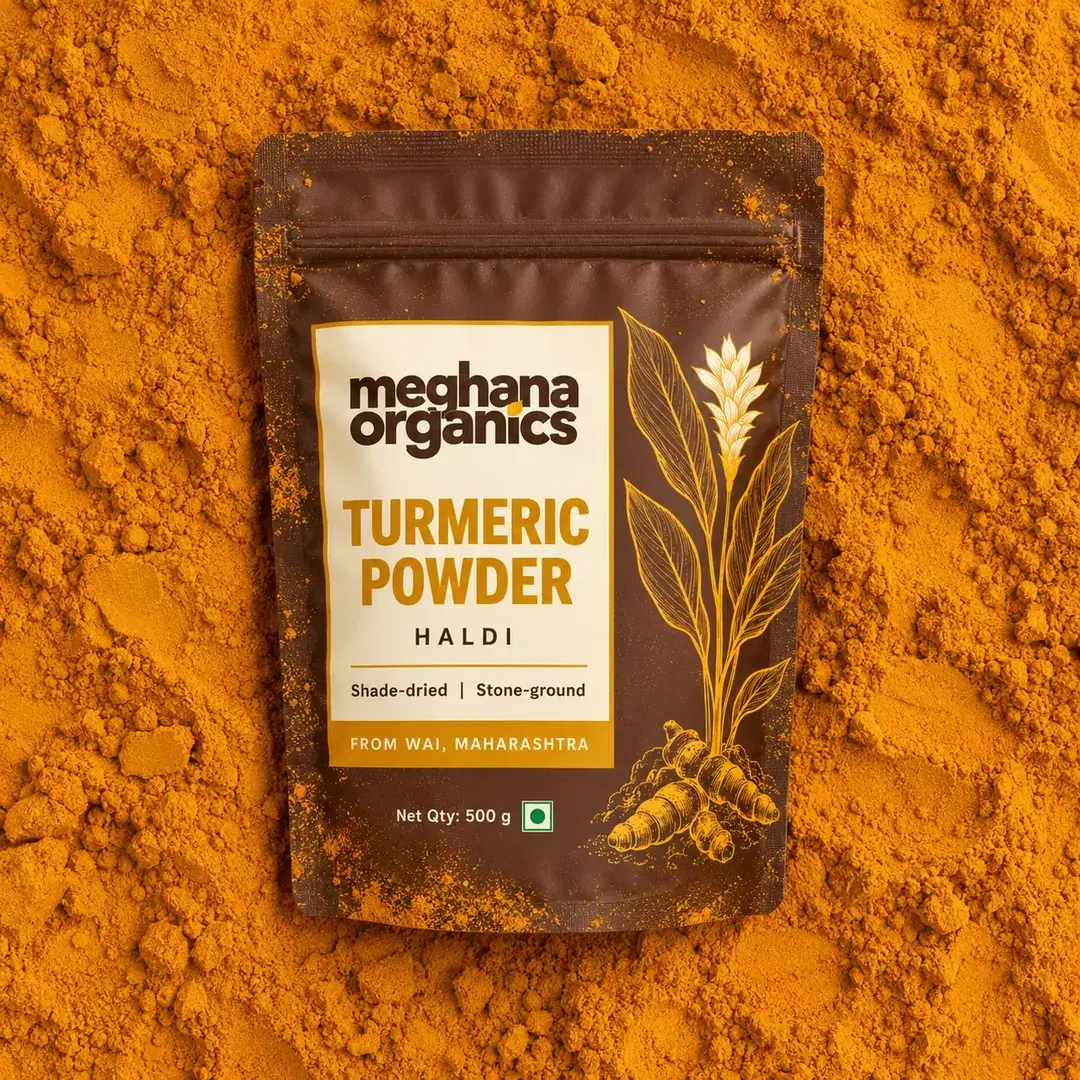
Turmeric Powder (Haldi)
From our family farm in Wai, Maharashtra. Shade-dried and stone-ground, with nothing added. 250g ₹299, 500g ₹549, 1kg ₹999.
Written by Meghana Organics Team
We are the family behind Meghana Organics. Our haldi grows on our farm in Wai, Maharashtra, and we cook with it every day. Here we write about how it is made, how to choose and store it, and how we use it.