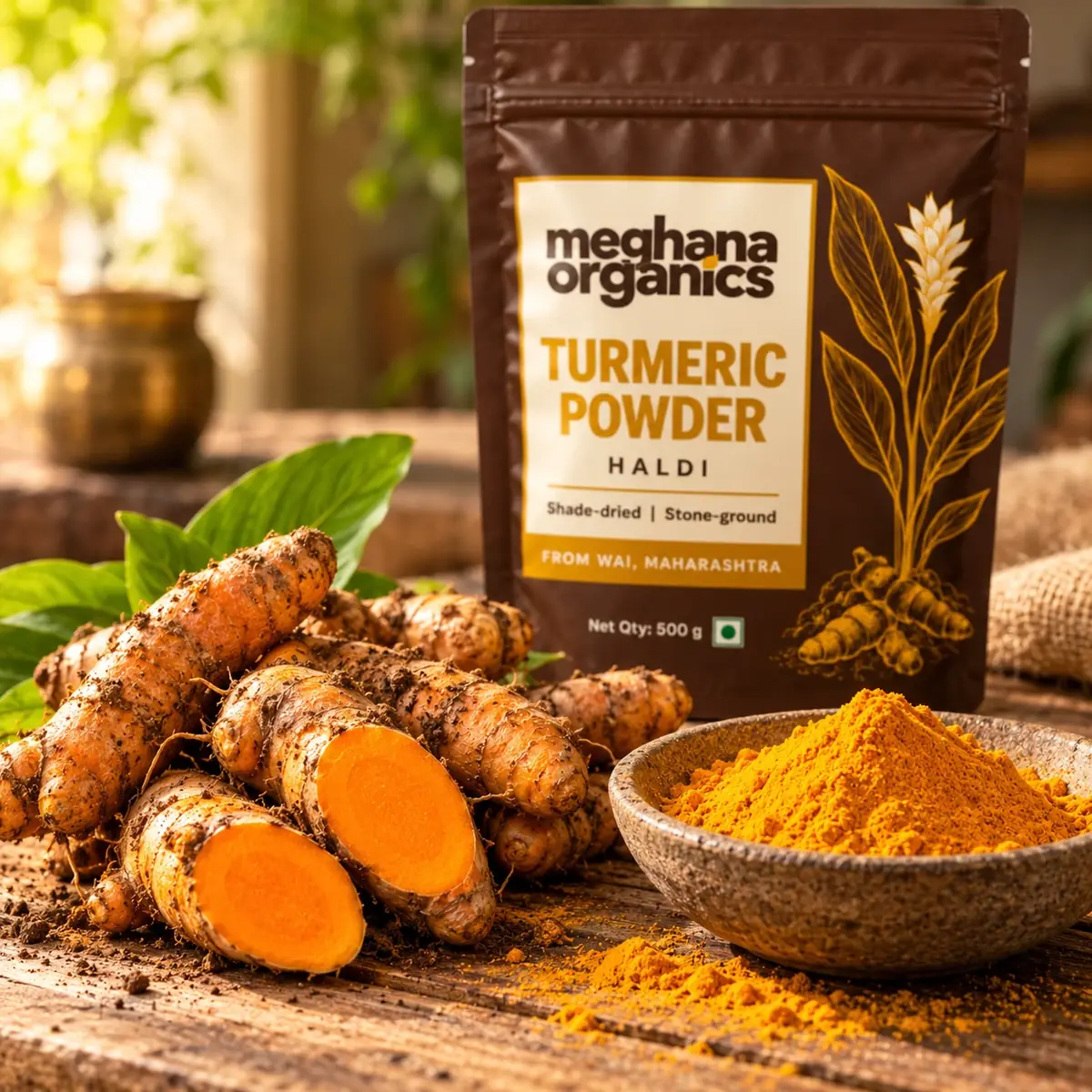
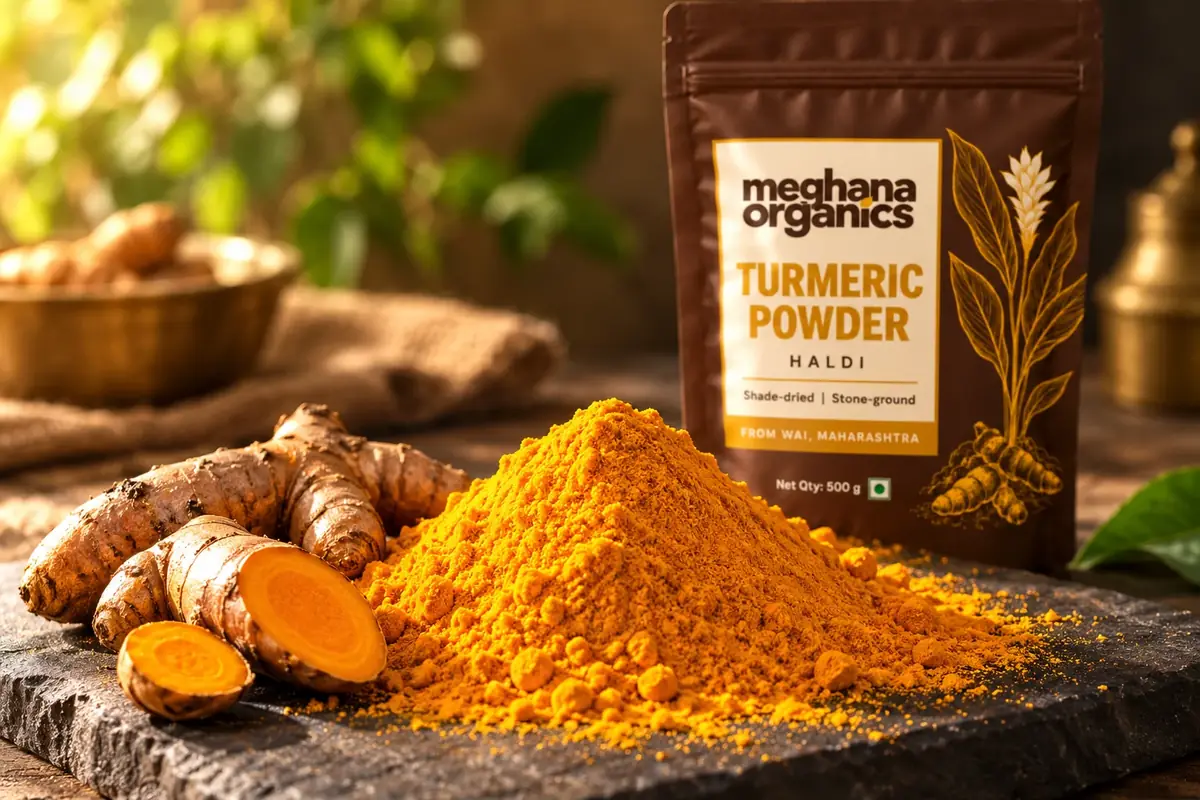
The best turmeric powder (haldi) in India is the pack that costs least per 100 g, delivery included, and still passes the basic checks: turmeric is the only ingredient, the label shows an FSSAI licence number, the packer's full address and the dates, it smells earthy rather than musty, and it passes FSSAI's home water test. For everyday cooking, price per 100 g decides most of it. For haldi doodh (turmeric milk) and ubtan (a face and body paste), which use a quarter teaspoon at a time, smell and what is in the pack matter more.
We grow and sell haldi ourselves, so this guide does not rank brands. It sorts what you can buy into four kinds and matches them to uses. Our buying checklist goes into more detail.
How to compare turmeric powders
Price per 100 g, with delivery
Add any delivery charge to the pack price, divide by the weight in grams and multiply by 100. Delivery can change the answer: a 200 g pack at ₹150 with ₹50 delivery costs ₹100 per 100 g, not ₹75.
Compare the price you will pay, not the MRP (maximum retail price). On the grocery app we checked in November 2026, big-brand packets sold 14% to 40% below MRP. Where an app prints a unit price, check whether it is per gram or per 100 g.
Four things on the label
- Ingredients: turmeric only. As a single-ingredient food, plain haldi needs no ingredient list. If a list names starch, colour or anything else, it is not plain haldi powder, which FSSAI's standard keeps free of added colour and foreign starch.
- FSSAI logo and licence number. The brand owner's 14-digit number, plus the packer's if a different business packed it.
- The packer's name and full address. FSSAI asks for a complete address, so a city name alone falls short.
- The dates. A packing date and an expiry or use-by date are compulsory; "best before" is optional. Online listings need not show the dates, so check them when the pack arrives.
Our label guide explains every line.
Colour and smell
FSSAI's standard says haldi powder must have its characteristic odour and flavour, free from mustiness or any foreign smell. Rub a pinch between your fingers: it should smell earthy, warm and a little bitter, never musty, sour or chemical.
Colour is harder to judge, since the shade varies with the variety and the processing. It also sells: a good-practice guide from ICAR-IISR (the Indian Institute of Spices Research) notes that the colour of processed turmeric influences its price. Be wary of a neon, lemon-bright yellow, because FSSAI allows no added colour in haldi powder.
The water test
FSSAI's DART guide (Detect Adulteration with Rapid Test) suggests adding a teaspoon of powder to a glass of water and watching it settle. Haldi with nothing added leaves a light yellow tint, while a strong yellow colour in the water suggests added colour. It is a rough screen, not proof, as our guide to checking turmeric powder at home explains.
Four kinds of haldi you can buy in India
The prices below come from listings we opened in November 2026: big-brand packets on a large grocery app, and farm and specialty packs on their sellers' own sites. They exclude delivery and change often.
| Kind | What it is | Price per 100 g, as seen online in November 2026 | What to check | Who it suits |
|---|---|---|---|---|
| Big-brand packet | A sealed pouch or jar from a spice company, sold in kirana (neighbourhood grocery) shops and on grocery apps | About ₹20 to ₹50 | The label checks and the water test | Everyday cooking on a budget |
| Loose powder from a market or mill | Sold by weight from an open sack, or ground for you at a chakki (local flour mill) | Varies | No label: ask where it grew and when it was ground, smell it and water-test it. Divide the price per kg by 10 | Cooks who know the shop or miller and buy small amounts often |
| Single-origin farm pack | From one named farm or farmers' group, often sold online direct | About ₹55 to ₹80 | The farm and place named, the full label and the delivery charge | People who want to know who grew their haldi |
| High-curcumin specialty variety | Sold on the name of a variety or region known for high curcumin, often with a percentage on the front | About ₹100 to ₹240 | A lab report for the batch behind the figure, and where it grew | People who want high curcumin and will read the report |
Loose haldi can be fine from a shop you know, but every check is yours. If you have whole haldi ground, test a few pieces first: FSSAI's DART guide says whole haldi with nothing added leaves no colour in a glass of water, while coloured fingers look bright and leave colour at once.
On a specialty pack, the curcumin percentage is the seller's claim until you see the batch's lab report. ICAR-IISR notes that Indian turmerics are mostly known by the name of the place they are grown, alongside improved varieties from research institutes, so a name alone says little about the pack in your hand. Our guide to turmeric varieties in India compares the best-known ones.
The best pick for each use
Everyday cooking
Dal (lentils) and sabzi (a cooked vegetable dish) use a little haldi daily, about a quarter teaspoon for a cup of raw dal that serves four. That adds up, so price per 100 g matters most here. Pick a sealed big-brand or farm pack that passes the checks, at the lowest price per 100 g with delivery. Buy a size you will finish well before the expiry date, and keep it closed and dry.
Haldi doodh
In haldi doodh, haldi is the main flavour, so pick a powder whose smell you like over the cheapest one. US Department of Agriculture data puts a teaspoon of ground turmeric at about 3 g, and our haldi doodh recipe uses a quarter teaspoon a cup, under a gram. Even at ₹240 per 100 g, that costs under ₹2 a cup.
Ubtan
Ubtan goes on your skin, so use a sealed powder with turmeric as its only ingredient rather than loose powder you cannot trace. A high-curcumin pack is not needed: the classic recipe uses a quarter teaspoon, and more haldi only makes the paste yellower. Patch-test on your inner forearm first, and expect a faint yellow tint that usually washes off. See our ubtan guide for the recipe.
Where our haldi fits
This is our own product, so read this part as a seller describing it. Our Turmeric Powder (Haldi) is a single-origin farm pack, grown on our family's farm in Wai, in Satara district, Maharashtra, then harvested, boiled, shade-dried and stone-ground, with no added colour, fillers or preservatives. Our family has cooked with this haldi for years and now sells it, and the pack says "From Wai, Maharashtra".
- 250 g for ₹199, which is ₹79.60 per 100 g
- 500 g for ₹299, which is ₹59.80 per 100 g
- 1 kg for ₹499, which is ₹49.90 per 100 g
Delivery is ₹79 per order across India, free on orders of ₹999 or more. With delivery, one 250 g pack works out to ₹111.20 per 100 g and one 1 kg pack to ₹57.80. That is more than the big-brand packets we saw, so if the lowest price per 100 g is your goal for everyday cooking, a big-brand packet that passes the checks will usually cost less. What our pack adds is the name of the farm and the place.
We state 6%+ curcumin. That is our own figure, with no published lab report yet, so read it as our claim, and run the same checks on our haldi as on any other.
Common questions
Which turmeric powder is best for daily cooking in India?
The one that passes the label, smell and water checks at the lowest price per 100 g, delivery included. On the prices we saw in November 2026, that is usually a big-brand packet, at about ₹20 to ₹50 per 100 g.
Is a brighter yellow haldi better?
No. The shade varies with the variety and the processing, and FSSAI allows no added colour in haldi powder, so an unusually bright, lemon-yellow powder deserves the water test before it goes into your food.
Does a higher curcumin figure mean a better powder?
Not on its own. FSSAI's standard sets a floor of 2.0% curcuminoid content, on a dry basis, for all haldi powder. Any figure above that is the seller's claim until you see a lab report for the batch, and for cooking, the smell and what is in the pack matter as much.
What does the FSSAI number on a pack tell me?
It identifies the licensed or registered business that answers for the pack, which you need if something goes wrong. It is not a test result for the batch in your hand.
Sources
- FSSAI (Eat Right India), DART: Detect Adulteration with Rapid Test, tests 14 and 15 for turmeric
- FSSAI, Food Product Standards, chapter 2.9 (version 4, 1 August 2025): standard 2.9.18 for turmeric (haldi) powder
- FSSAI, Labelling and Display Regulations, 2020 (compendium, July 2022)
- ICAR-Indian Institute of Spices Research, Turmeric: Good Agricultural Practices (2019), on the Spices Board India website
- USDA FoodData Central, Spices, turmeric, ground (SR Legacy 172231): portion weights
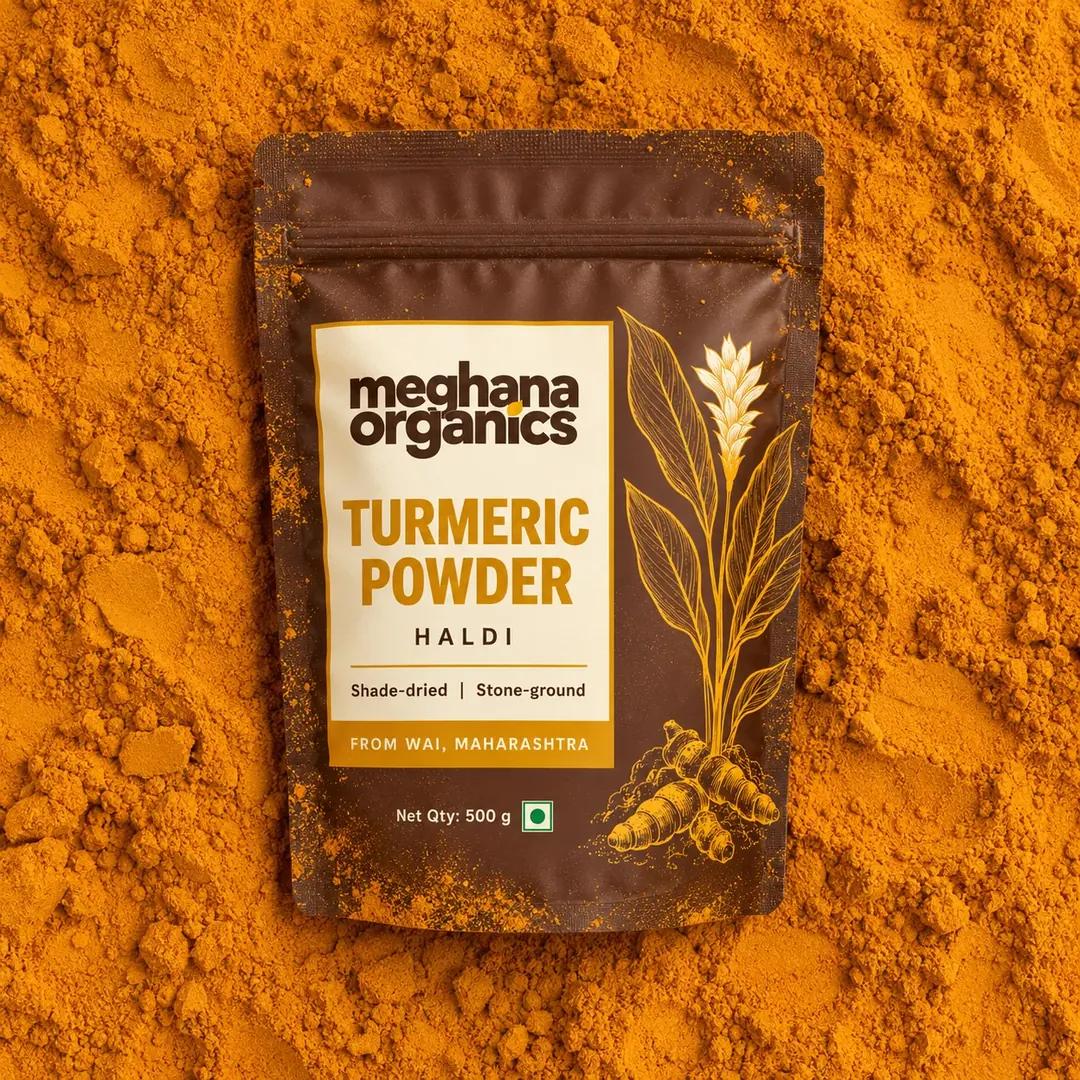
Turmeric Powder (Haldi)
From our family farm in Wai, Maharashtra. Shade-dried and stone-ground, with nothing added. 250g ₹199, 500g ₹299, 1kg ₹499.
Written by Meghana Organics Team
We are the family behind Meghana Organics. Our haldi grows on our farm in Wai, Maharashtra, and we cook with it every day. Here we write about how it is made, how to choose and store it, and how we use it.