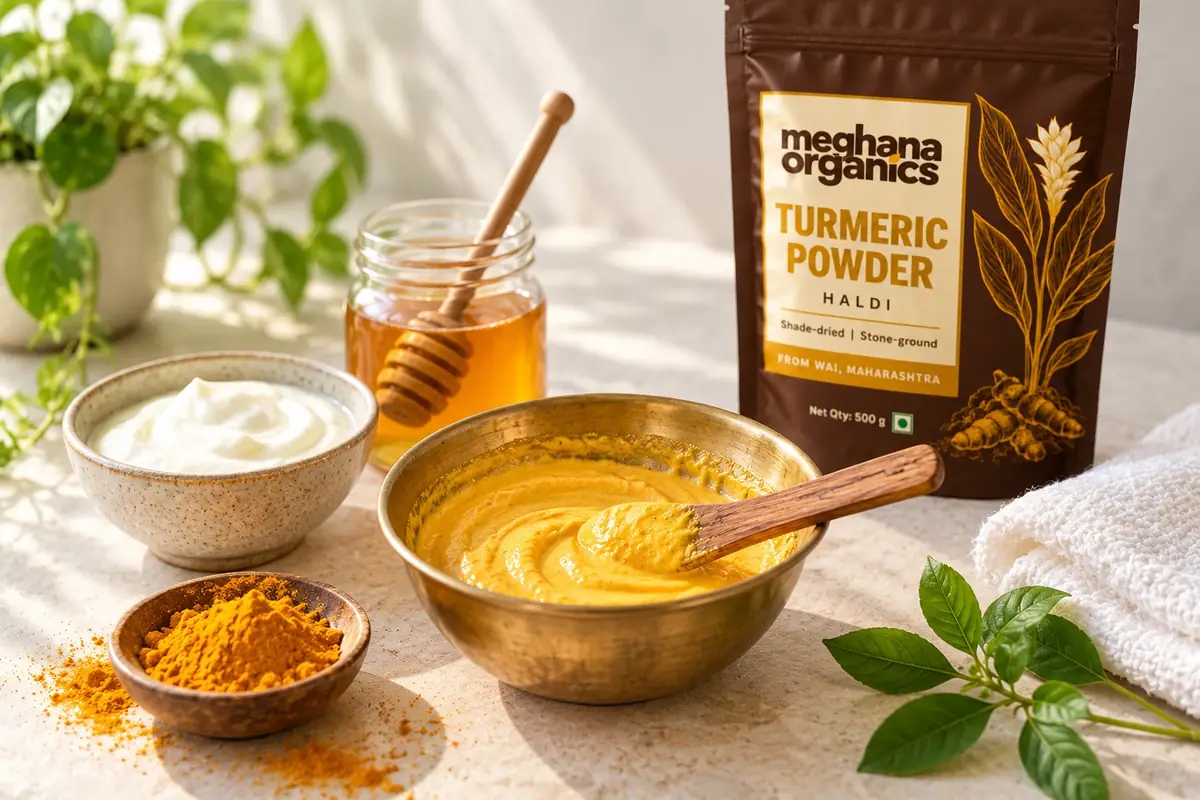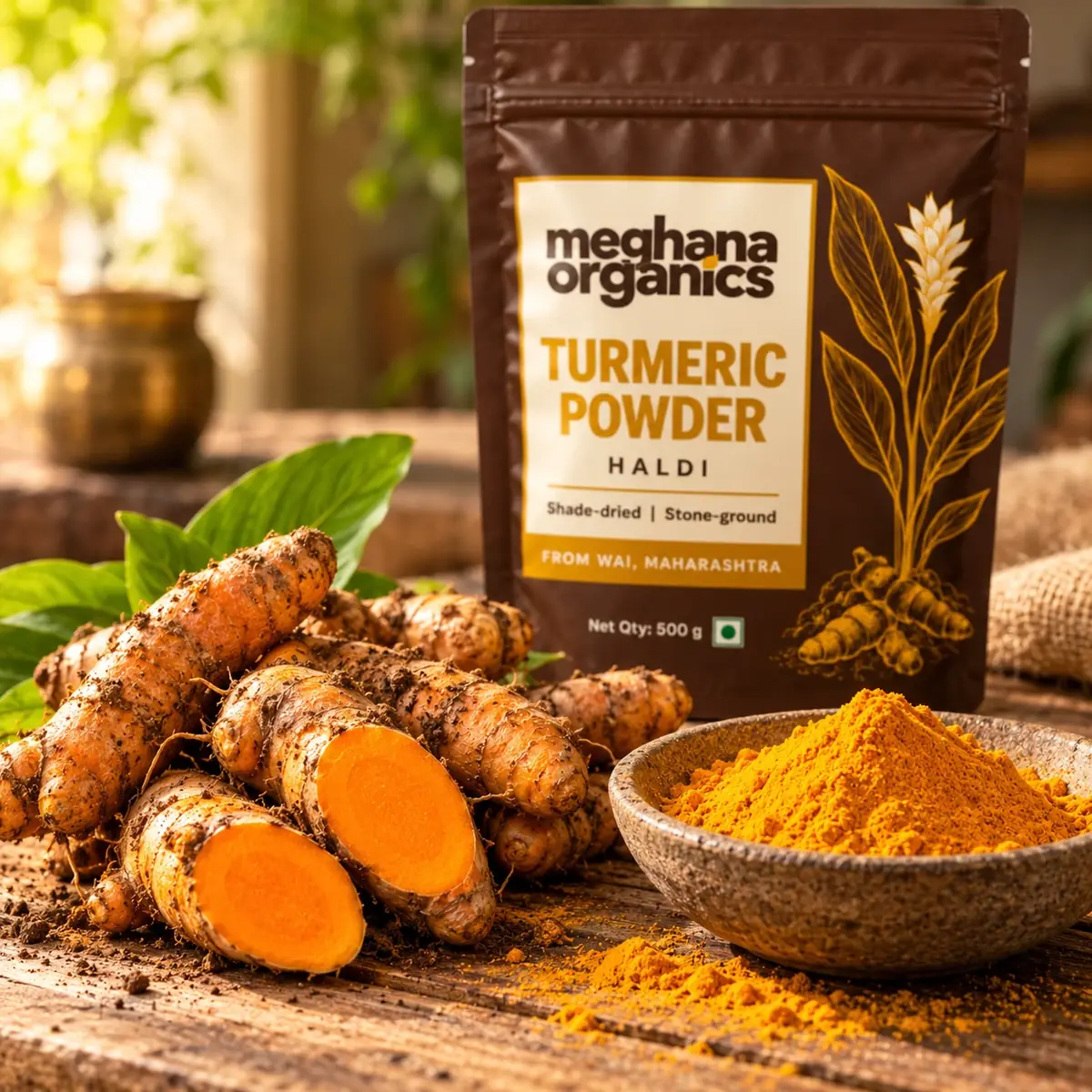
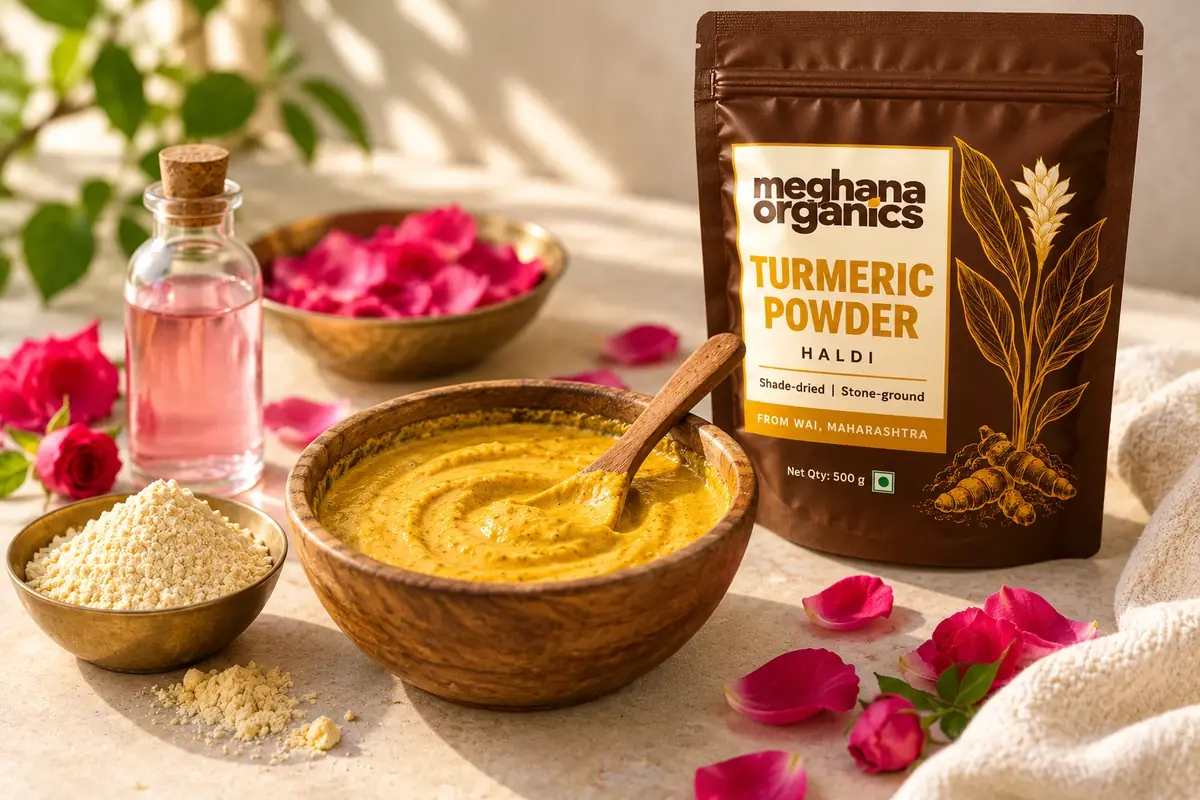
Ubtan is a traditional Indian paste for the face and body, and the classic version is simple: 2 tablespoons of besan (gram flour) and 1/4 teaspoon of haldi, mixed with milk into a smooth paste. You spread a thin layer, leave it for 10 to 15 minutes until it dries, then rub it off with wet fingers and rinse. In Ayurveda, haldi (haridra in Sanskrit) is traditionally used to support skin glow; see our skin glow collection for more.
This guide gives the classic recipe, two variations, how to apply and wash it off, and the two things to do first: patch-test the paste, and check that your haldi has nothing added to it.
What ubtan is and where it comes from
Ubtan belongs to the same family as udvartana, the Ayurvedic practice of rubbing the body with herbal powders. A review of the Ayurvedic seasonal routines lists udvartana with powders of sandalwood (chandana) and saffron (kesara) among the spring routines. In many Indian homes the everyday version became a paste of besan, haldi and milk or curd, used before a bath.
Haldi has a place in Indian life well beyond the kitchen. ICAR-IISR (the Indian Institute of Spices Research) describes turmeric as used as a condiment, a dye and a cosmetic, and in religious ceremonies. The pre-wedding haldi ceremony, where family members smear haldi paste on the bride and groom, is the best-known example. We write about it, and about halad kunku (haldi and kumkum), in the haldi ceremony and halad kunku explained.
Classic besan and haldi ubtan
Ingredients
- 2 tablespoons besan (gram flour)
- 1/4 teaspoon haldi (turmeric powder)
- 2 to 3 tablespoons cool milk or plain water, added a spoon at a time
Method
- Wash your face with lukewarm water, pat it dry and tie your hair back.
- Mix the besan and haldi in a small bowl. Add the milk one spoon at a time, stirring, until you have a smooth paste that just holds on a tilted spoon.
- With clean fingers, spread a thin, even layer over your face and neck. Keep it away from your eyes and lips. A thin layer is enough, and a thick one cracks as it dries.
- Leave it for 10 to 15 minutes, until it feels dry but is not cracking.
- Wet your fingers and rub the pack off in small circles. This is the traditional way, and it lifts the dried besan gently. Rinse with lukewarm water, pat dry and moisturise as usual.
Make the paste fresh each time and use it all. Start with once a week. These amounts cover the face and neck; for the arms or back, make a larger batch in the same proportions.
Two variations
With curd
Mix 2 tablespoons of besan, 1/4 teaspoon of haldi and 2 tablespoons of thick plain curd (dahi) into a smooth paste, adding a few drops of water if it is too thick. Curd makes a creamier paste that spreads more easily. Apply and wash off exactly as above, and rinse well so no curd is left on your skin.
With sandalwood or rose water
Mix 2 tablespoons of besan, 1/4 teaspoon of haldi, 1 teaspoon of sandalwood (chandan) powder and about 2 tablespoons of rose water into a smooth paste. Sandalwood and rose water are two classic additions to ubtan. Apply and wash off as above.
Patch-test first
Any new paste can irritate skin, even one made from a familiar spice. Before your first face pack, patch-test it: mix a little paste and dab it on the inside of your forearm. Leave it on for the usual 10 minutes, rinse it off, then watch the spot for 24 hours. If you see redness, itching or stinging, do not use the pack on your face.
- Skip the pack on cuts, sunburn, active rashes and very sensitive skin.
- Keep the paste out of your eyes. If it gets in, rinse with plenty of cool water.
- If your skin feels irritated at any point, rinse the pack off straight away and stop using it.
This is traditional use, not medical advice. If you have a skin condition, or skin that reacts easily, ask a doctor before trying a new pack.
Haldi can leave a yellow tint
Haldi is a dye as well as a spice, so it can leave a faint yellow tint on your skin, and it stains towels, basins and light clothes. A little goes a long way: more haldi does not make the pack work better, only yellower. Rinse well, wash with a gentle cleanser if a tint stays, wear an old top and keep a dark towel handy. The tint usually washes off.
Use a haldi with nothing added to it. Some low-grade powders are cut with synthetic yellow dyes such as metanil yellow, which FSSAI lists as an adulterant to test for in turmeric powder, and you do not want that on your face. Our guides to metanil yellow in turmeric and to spotting fake turmeric powder explain more. Ours is Turmeric Powder (Haldi) from our family's farm in Wai: shade-dried and stone-ground, with no added colour, fillers or preservatives.
How we think about ubtan
We share ubtan as a tradition: a simple, pleasant ritual with a pantry spice, as many Indian families have done at home. It is not a promise about what it will do for your skin, and it does not replace the advice of a doctor or dermatologist for any persistent skin concern.
Sources
Turmeric Powder (Haldi)
From our family farm in Wai, Maharashtra. Shade-dried and stone-ground, with nothing added. 250g ₹299, 500g ₹549, 1kg ₹999.
Written by Meghana Organics Team
We are the family behind Meghana Organics. Our haldi grows on our farm in Wai, Maharashtra, and we cook with it every day. Here we write about how it is made, how to choose and store it, and how we use it.