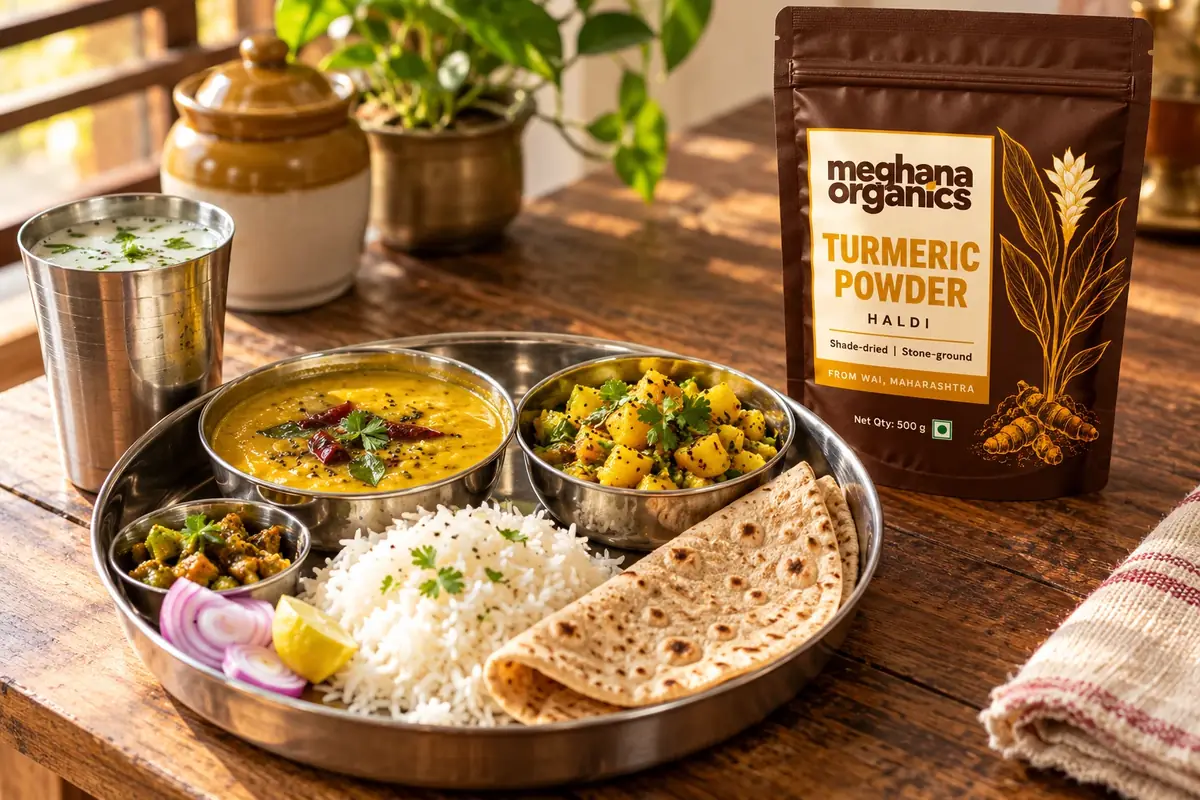
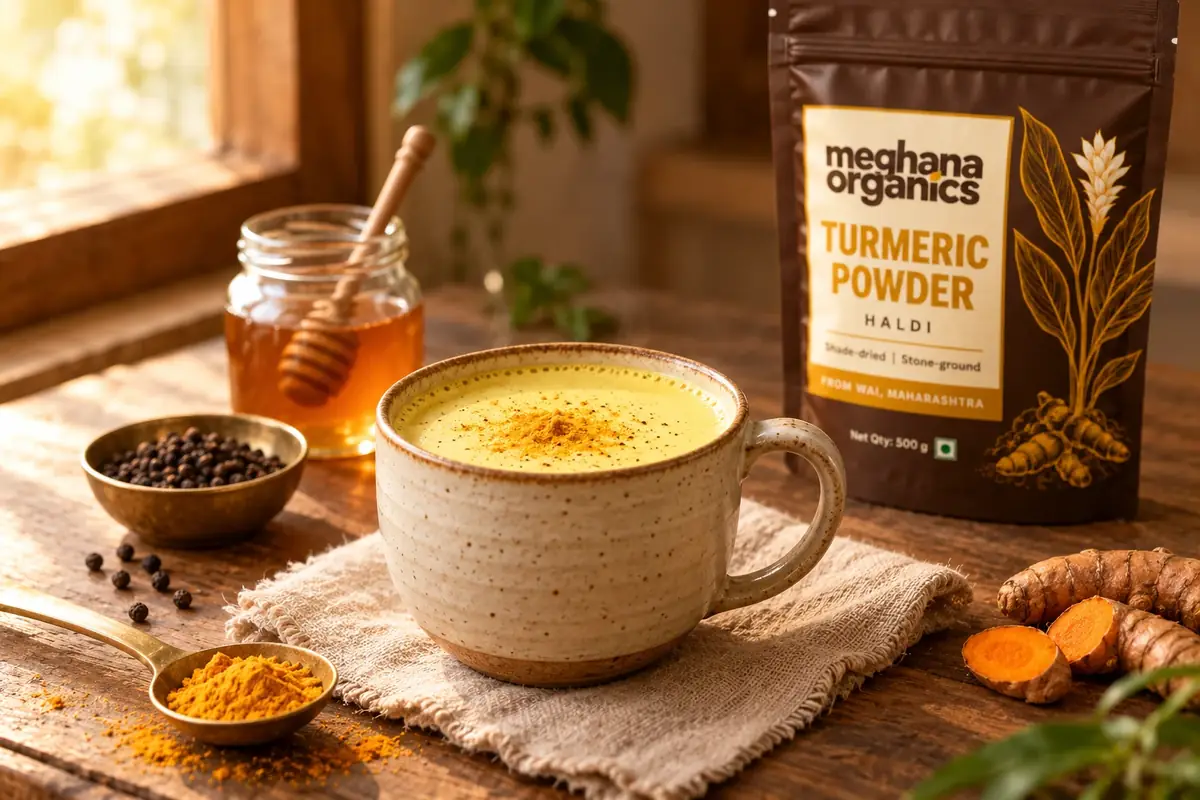
Haldi doodh is turmeric milk: one cup of milk simmered for a few minutes with 1/4 teaspoon of haldi (turmeric powder) and a pinch of black pepper, then lightly sweetened. This version takes about 10 minutes and makes one cup. In Ayurveda, haldi (haridra in Sanskrit) with warm milk is a traditional evening drink to support immunity.
Outside India the same drink is often sold as golden milk. Below are the recipe with amounts and timings, why black pepper and ghee (clarified butter) are in the cup, four variations, and a note on how much to have.
Haldi doodh recipe
Makes: 1 cup (250 ml). Time: 2 minutes to prepare, about 6 minutes on the stove.
Ingredients
- 1 cup (250 ml) whole milk, cow or buffalo
- 1/4 teaspoon haldi (turmeric powder)
- 1 small pinch of freshly crushed black pepper, about 1/8 teaspoon
- 1/2 teaspoon ghee, optional
- 1 teaspoon jaggery (gur) powder or honey, or to taste
Method
- Pour the milk into a small, heavy-bottomed pan and set it over medium heat. Stir now and then until steam rises and tiny bubbles form at the edge, about 2 minutes.
- Add the haldi, black pepper and ghee. Whisk well so the haldi does not clump. If it does, stir the haldi into 1 tablespoon of cool milk first to make a smooth paste, then add the paste to the pan.
- Lower the heat and simmer gently for 3 to 4 minutes, stirring often. Watch the pan, because milk rises fast. This gentle simmer takes the raw edge off the haldi.
- Switch off the heat and let the milk cool for a minute or two, until it is comfortable to sip.
- Stir in the jaggery until it dissolves. If you are using honey, add it only now: honey is traditionally not heated.
- Pour into a cup and drink it warm. Some haldi always settles at the bottom, so stir before the last few sips.
For two cups, double everything and simmer for 5 minutes. Use a pan with plenty of room above the milk so it does not boil over, and wipe up haldi spills straight away, as they stain. We make this with our own haldi, Turmeric Powder (Haldi) from the family farm in Wai.
Why black pepper and ghee are in the cup
Many Indian recipes pair haldi with some fat, such as ghee, oil or milk, and often a pinch of black pepper. Haldi doodh follows the same habit: the milk and ghee bring the fat, and the pepper brings its warmth. There is also a reason behind the pepper. Curcumin, the pigment in haldi, is poorly absorbed when taken on its own, and piperine in black pepper may increase how much is absorbed by slowing its breakdown, according to the Linus Pauling Institute at Oregon State University.
Our guide to black pepper and turmeric explains what the best-known study found, and why it does not tell you much about a cup of milk.
Four variations
Dairy-free coconut haldi doodh
Swap the milk for 1 cup of coconut milk (from a carton, or canned coconut milk mixed half and half with water). Use 1/2 teaspoon of coconut oil instead of ghee, heat gently for 3 minutes and sweeten with jaggery or maple syrup. Oat or almond milk also work, though they make a thinner cup.
With ginger
Crush a 1 cm piece of fresh ginger and simmer it in 2 tablespoons of water for 1 minute, then add the milk and carry on as above. Strain before drinking. The head start in water helps because fresh ginger can curdle hot milk. In a hurry, use 1/8 teaspoon of dry ginger powder (sonth) instead.
With saffron and nuts
Soak 4 or 5 saffron strands in 1 tablespoon of warm milk for 10 minutes. Add them to the pan with 1 crushed green cardamom pod at step 2. Top the cup with a few thinly sliced almonds and pistachios. This is the version for festive evenings.
Winter spice
Add 1/4 teaspoon of cinnamon powder, a tiny pinch of freshly grated nutmeg and 1 crushed cardamom pod at step 2, then strain into a mug.
Haldi doodh and the turmeric latte
A turmeric latte is a frothier, quicker cousin of haldi doodh: the milk is only warmed, not simmered, and the spices are whisked in. If you want it frothy, or want a spice mix ready in a jar, see our turmeric latte recipe.
Tradition, and how much to have
A review in Nutrients describes turmeric as a staple seasoning across South Asia, known in India as haldi, with a warm, slightly bitter flavour. In Ayurveda, haldi is traditionally used to support immunity, and a cup of haldi doodh in the evening is the everyday form of that tradition. You will find more ways to cook with it in our immune support collection.
Research is a separate matter. Most curcumin studies use concentrated extracts at doses far above what a quarter teaspoon of haldi in a cup of milk provides, so their results do not carry over to this drink. The US National Center for Complementary and Integrative Health says we do not yet know enough to say whether turmeric or curcumin is beneficial for any health purpose. We make haldi doodh for its taste, its warmth and the tradition.
A food, not a medicine. If you are pregnant or nursing, take regular medication or have a health condition, check with your doctor before taking more than cooking amounts.
Sources
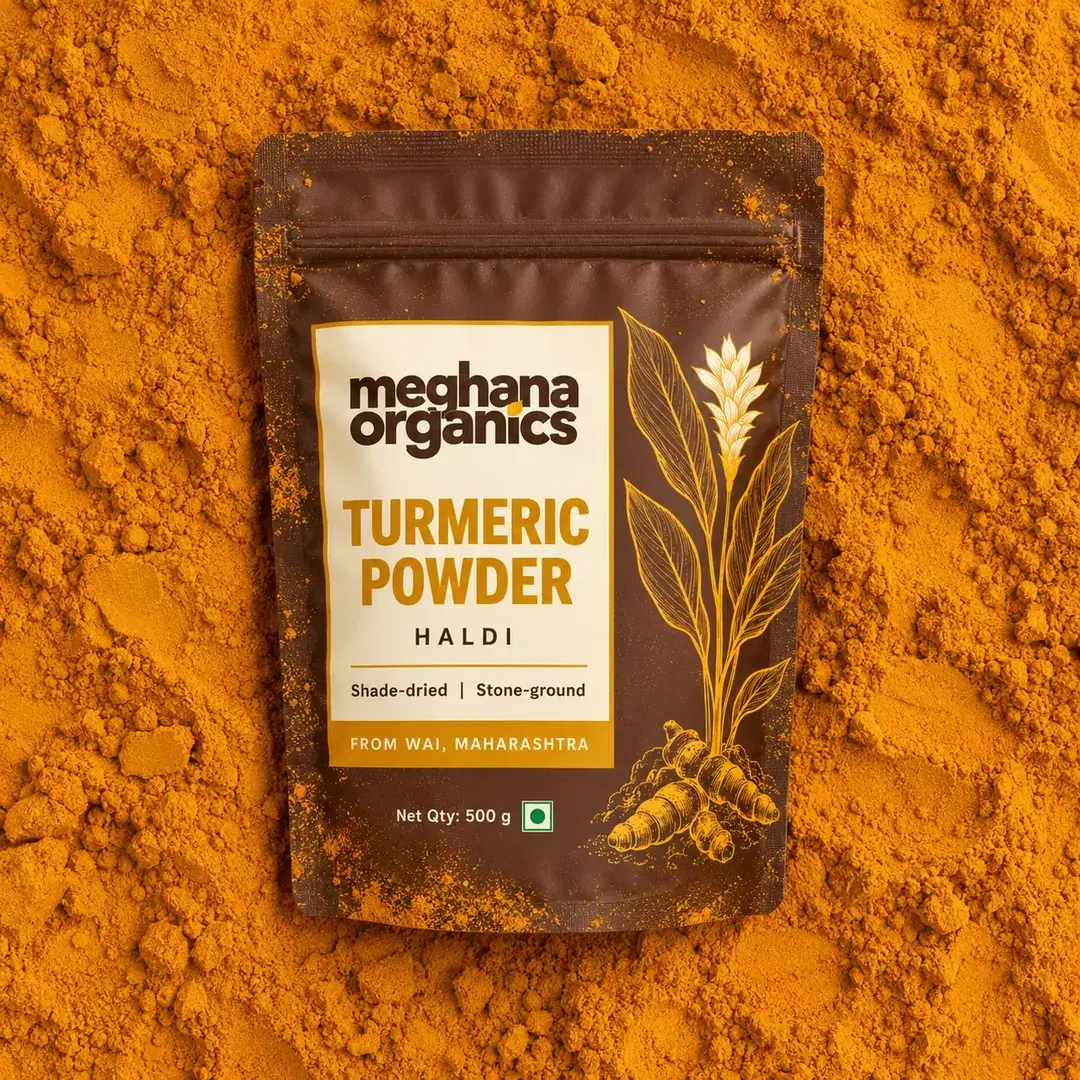
Turmeric Powder (Haldi)
From our family farm in Wai, Maharashtra. Shade-dried and stone-ground, with nothing added. 250g ₹299, 500g ₹549, 1kg ₹999.
Written by Meghana Organics Team
We are the family behind Meghana Organics. Our haldi grows on our farm in Wai, Maharashtra, and we cook with it every day. Here we write about how it is made, how to choose and store it, and how we use it.