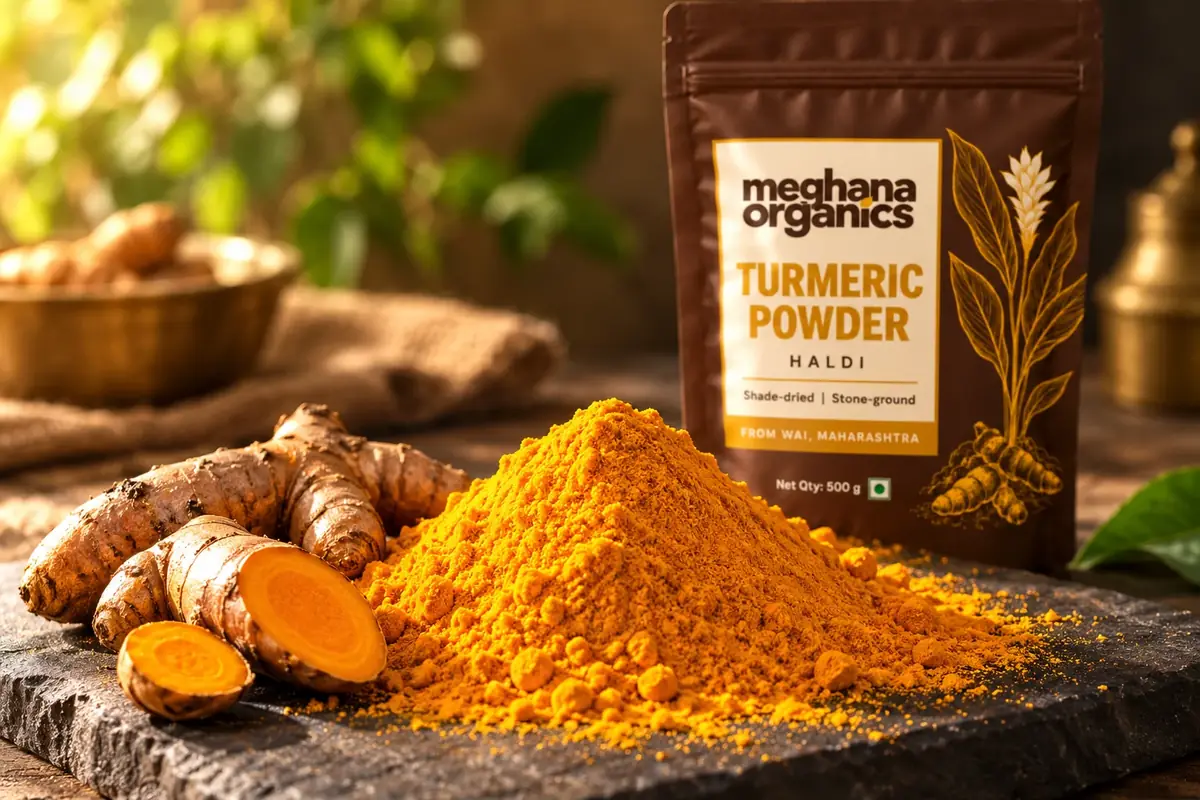
Haldi (हल्दी) means turmeric: it is the Hindi word for the yellow spice ground from the dried root of the plant Curcuma longa. Halad (हळद) is the same word in Marathi, and kachi haldi (कच्ची हल्दी) means fresh or raw turmeric root. Two look-alike names, amba haldi and kasturi manjal, belong to different plants.
Turmeric in eight Indian languages
The words are close relatives. Hindi haldi, Marathi halad and Bengali holud all trace back to the Sanskrit haridra, a word built on hari, meaning yellow or tawny. In Tamil and Bengali, the word for turmeric also means yellow.
| Word | Language | Script | Good to know |
|---|---|---|---|
| Turmeric | English | – | The spice from the dried, ground root of Curcuma longa, a plant in the ginger family |
| Haldi | Hindi | हल्दी | The plant and the powder |
| Halad | Marathi | हळद | The plant and the powder |
| Haridra | Sanskrit | हरिद्रा | The older word behind haldi, halad and holud. Ayurveda uses this name |
| Manjal | Tamil | மஞ்சள் | Also means yellow |
| Manjal | Malayalam | മഞ്ഞൾ | Related to the Tamil word |
| Pasupu | Telugu | పసుపు | Also the yellow colour of turmeric |
| Arishina | Kannada | ಅರಿಶಿನ | Also spelt arisina (ಅರಿಸಿನ) |
| Holud | Bengali | হলুদ | Also spelt halud. Also means yellow |
Spellings vary because these sounds do not map neatly onto the Latin alphabet, so you will see holud or halud, arishina or arisina, and kachi or kachchi haldi. Gujarati has haldar (હળદર), and English-language texts sometimes call turmeric Indian saffron.
Words for the fresh and dried root
| Word | Language | Script | Meaning |
|---|---|---|---|
| Kachi haldi | Hindi | कच्ची हल्दी | Fresh or raw turmeric root. Also spelt kachchi haldi |
| Oli halad | Marathi | ओली हळद | Fresh turmeric root. Oli means wet |
| Halkund | Marathi | हळकुंड | The dried turmeric root, before it is ground into powder |
Kachi haldi: fresh turmeric root
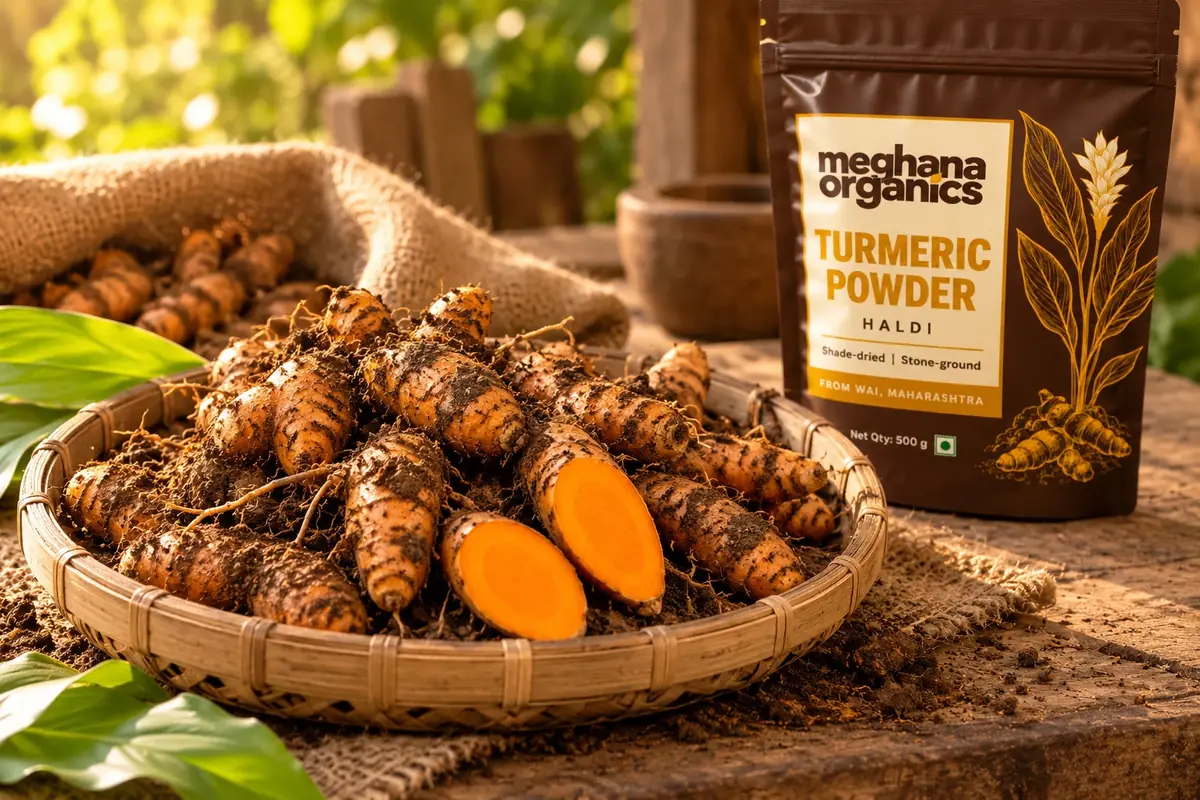
Kachi (कच्ची) means raw, unripe or uncooked in Hindi, so kachi haldi is turmeric as it comes out of the ground, before it is boiled, dried and ground. It is the same plant as the powder in your masala dabba (spice box): Curcuma longa. What we call the root is strictly a rhizome, an underground stem. Cut open, it is bright yellow-orange, and the skin looks a little like ginger's.
Fresh turmeric is a late-winter ingredient in India: the crop is generally harvested from January to March, according to ICAR-Indian Institute of Spices Research. When it reaches the markets, Rajasthani kitchens make kachi haldi ki sabzi, a curry of the fresh root with yogurt and ghee (clarified butter), and Maharashtrian kitchens make lonche (pickle) from oli halad with ginger, green chilli and lemon, adding amba halad when they can find it. Our guide to kachi haldi vs haldi powder covers storage, how to swap fresh for powder and when to use each.
From kachi haldi to haldi powder
The powder and the fresh root are one plant at two stages. Most turmeric is boiled soon after harvest, within three or four days according to ICAR-Indian Institute of Spices Research, then dried and ground. The institute notes that boiling avoids the raw odour of fresh turmeric, which is one reason kachi haldi and haldi powder smell and taste different. The dried root, before grinding, is the halkund of Marathi kitchens. Ground, it is halad or haldi.
Halad and halkund in Marathi
In Marathi, halad is both the plant and the powder. A Marathi dictionary defines the powder as the ground form of halkund, the dried root. You will also hear halad at halad-kunku, the gathering at which married women exchange turmeric and kunku (vermilion powder). Our guide to the haldi ceremony and halad-kunku explains the customs.
Amba haldi is mango ginger, not turmeric
Amba haldi (Marathi आंबेहळद, Hindi aam haldi, आम हल्दी) is Curcuma amada, called mango ginger in English. It belongs to the same genus as turmeric but is a different species. The rhizome smells of raw mango when bruised and lacks ginger's heat, and it is used in pickles and chutneys, not as a stand-in for haldi powder.
The names overlap from one region and one shop to the next. If you are unsure what you have bought, break a piece and smell it: mango ginger smells of raw mango, while turmeric is earthy.
Kasturi manjal is wild turmeric
Kasturi manjal (also spelt kasthuri manjal, the Tamil and Malayalam name) is wild turmeric, Curcuma aromatica. Its rhizome is cream-coloured with a distinctive fragrance, and it is widely used as a cosmetic ingredient in South Asia. A little is used to colour or flavour food in some places, but it is not interchangeable with haldi powder, so do not swap it into dal (lentils) or a sabzi. If a recipe for ubtan (the traditional gram-flour paste used on the skin) or a face pack asks for kasturi manjal, it means this plant, not kitchen haldi.
The four names side by side
| Name | Plant | What it is | Where you meet it |
|---|---|---|---|
| Haldi | Curcuma longa | Turmeric root, dried and ground into powder | Everyday cooking |
| Kachi haldi | Curcuma longa (the same plant) | The fresh root | Winter sabzi and pickles |
| Amba haldi | Curcuma amada | Mango ginger, with a raw-mango aroma | Pickles and chutneys |
| Kasturi manjal | Curcuma aromatica | Wild turmeric | Cosmetic use |
Reading a recipe
- Haldi or turmeric powder means the dried, ground spice, measured in pinches and teaspoons.
- Kachi haldi, fresh turmeric or raw turmeric means the root. Grate or chop it and use about three times as much by volume as you would powder.
- Amba haldi or mango ginger is a different plant. Use it only when a recipe names it, usually for pickles and chutneys.
- Kasturi manjal or wild turmeric is mostly for cosmetic recipes such as face packs. It is not a substitute for haldi in food.
Which one we sell
When this site says haldi, it means the first row. Our Turmeric Powder (Haldi) is the dried, ground root of Curcuma longa from our family farm in Wai, Maharashtra, shade-dried and stone-ground, with no added colour, fillers or preservatives. For amounts and methods, see our guide to how to use turmeric powder in cooking.
Sources
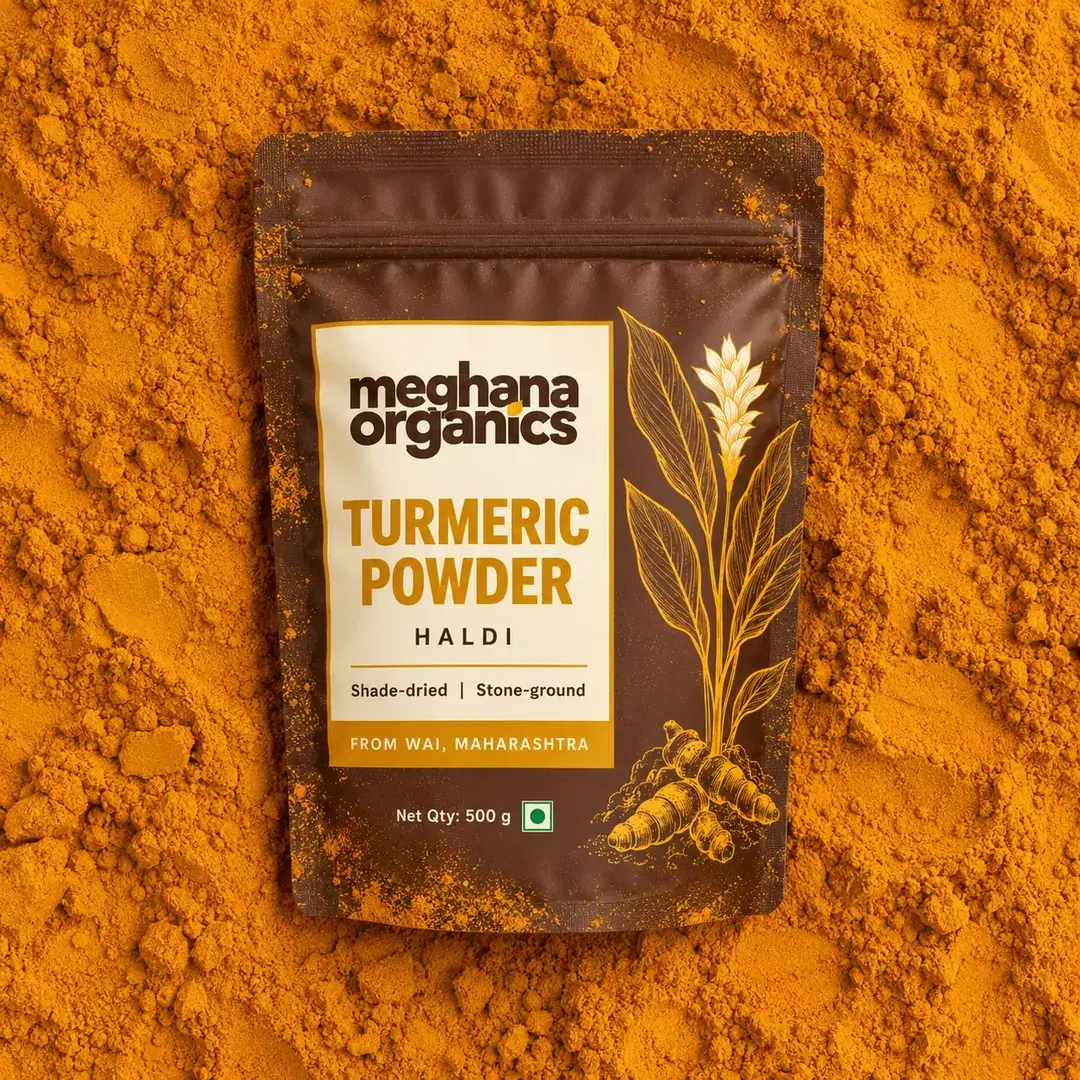
Turmeric Powder (Haldi)
From our family farm in Wai, Maharashtra. Shade-dried and stone-ground, with nothing added. 250g ₹299, 500g ₹549, 1kg ₹999.
Written by Meghana Organics Team
We are the family behind Meghana Organics. Our haldi grows on our farm in Wai, Maharashtra, and we cook with it every day. Here we write about how it is made, how to choose and store it, and how we use it.