In the market tests below, packed turmeric powder (haldi) came out better than loose haldi, but it was not spotless. A 2024 study of 356 turmeric samples from bazaars in India and three neighbouring countries found the very high lead levels in loose powder and polished whole roots, and FSSAI (the Food Safety and Standards Authority of India) found no lead chromate in any of the 258 packed turmeric samples in its 2022 survey. Three branded packs in the 2024 study were still over India's lead limit, so a labelled pack is a better start, not proof.
Lead chromate is a yellow pigment that contains lead and has been added to turmeric to brighten it. Farm samples tested in 2026 suggest the lead gets in after harvest, not from the soil.
What the studies found
A 2024 study across South Asia
A Stanford-led team trained local shoppers to buy turmeric at the largest wholesale market and the largest retail bazaar in 23 cities between December 2020 and March 2021. Of the 356 samples, 269 came from 17 Indian cities and the rest from Pakistan, Nepal and Sri Lanka. Overall, 14 percent had detectable lead and 7 percent were above India's limit of 10 mg per kg. Across all four countries, the forms compared like this:
- Loose powder: 5 of 90 samples were over the limit, four of them above 100 mg per kg, and the highest had 1,665.
- Packed powder: none of the 28 samples listed as packaged powder was over the limit (the highest had 5 mg per kg), but 3 of the 58 branded packs were, the highest at 82.
- Whole roots: 14 of 143 polished roots were over the limit, the highest at 2,935 mg per kg, against 2 of 37 unpolished roots, the highest at 18.
Readings above 1,000 mg per kg turned up only in polished roots and loose powder. In India the worst results came from Patna, Bihar, where 11 of 12 samples were over the limit, the highest at 2,274 mg per kg. Guwahati and Chennai had three over it between them, and the other 14 Indian cities had none. Samples with 18 mg per kg or more held lead and chromium in roughly the one-to-one proportion of lead chromate, which points to added pigment rather than soil or dust.
The authors write that, as in earlier studies, loose and under-regulated spices were more likely to be adulterated than packed turmeric, though India's lead limit is the same for both. They chose samples to cover as many kinds of turmeric as possible, not in proportion to what people buy, and sampled in a single season, so the figures show where problems were found, not what share of the haldi in a city is affected.
FSSAI's 2022 survey of packed spices
According to the health ministry's answer to a question in the Lok Sabha (the lower house of Parliament) in February 2024, FSSAI collected 3,582 spice samples from 249 locations across 35 states and union territories on 3 and 4 March 2022. Of these, 258 were packed turmeric, and the test for lead chromate was negative in all 258. The survey covered packed turmeric only, and the answer reports a lead chromate test rather than measured lead levels, so it tells you nothing about loose haldi.
Farm samples tested in 2026
In July 2026 the environmental research group Toxics Link reported on 13 samples of raw turmeric taken straight from farms in Maharashtra, Telangana, Tamil Nadu, Odisha, Karnataka and Madhya Pradesh. Tested at an NABL-accredited laboratory (NABL is the National Accreditation Board for Testing and Calibration Laboratories), they held from below 0.05 to 1.87 mg of lead per kg, well under the 10 mg limit. The group concludes that the high lead in market turmeric powder is unlikely to start on the farm, and points to processing, handling or deliberate adulteration after harvest. Thirteen samples is a small study, but it fits the 2024 paper's conclusion that the very high levels came from added pigment.
Our guide to metanil yellow and lead chromate covers a larger 2026 study of 503 samples from eastern Indian markets.
Label checks for packed haldi
A label tells you who answers for a pack, not what is inside it, which matters if something goes wrong. Under FSSAI's labelling regulations, a pack of haldi must show:
- the FSSAI logo with the brand owner's licence number, plus the maker's or packer's number if that is a different business;
- the brand owner's name and complete address;
- a batch, lot or code number;
- the date of manufacture or packing, and an expiry or use-by date.
Plain haldi is a single-ingredient food, so it needs no ingredient list, and a printed list that names anything besides turmeric means a blend. Online, the seller must show the label details before you pay, except the batch number and dates, so check those when the pack arrives. Loose haldi has no label, but every food business must display its FSSAI registration or licence number prominently on its premises, so look for it at the shop. Our line-by-line label guide covers the rest, from the MRP to customer care details.
What home tests can and can't tell you
FSSAI's DART booklet (Detect Adulteration with Rapid Test), written for households to raise awareness of food safety, has three quick checks for haldi. Each needs only a glass of water:
- Added colour in powder: add a teaspoon of powder to the water. Haldi without added colour leaves a light yellow as it settles, while FSSAI says a strong yellow points to adulteration.
- Lead chromate on whole haldi: put a few dried roots in the water. FSSAI says adulterated roots look bright and leave colour in the water at once.
- Sawdust or bran: sprinkle powder on the water. Sawdust or powdered bran floats.
What these checks cannot do is measure lead in powder. DART's only lead chromate check is for whole roots, and the 2024 and 2026 studies measured lead with specialist instruments such as X-ray fluorescence analysers and ICP-MS (inductively coupled plasma mass spectrometry). A clear glass does not show that a powder is free of lead, and colour alone is no verdict, because haldi varies in shade. Only a lab report tells you the lead level. Our guide to checking haldi at home walks through the tests and when to use a lab.
If you have whole haldi ground at a local chakki (flour mill), do the whole-root test first. In the 2024 study, polished roots carried the highest lead of any form.
Lead has no known safe level in children's blood. If a child, or someone who is pregnant, has been eating haldi you are unsure about, speak to a doctor. Lead exposure is checked with a blood test.
Loose and packed haldi side by side
| Factor | Loose | Packed | What to check |
|---|---|---|---|
| Lead in the 2024 study | 5 of 90 powders over India's limit, four above 100 mg per kg | None of 28 packaged powders; 3 of 58 branded packs, the highest at 82 mg per kg | A lab report covering lead for your batch, if the seller has one |
| Who answers for it | The shop, which must display its FSSAI registration or licence number | The brand owner on the label, with a complete address and FSSAI licence number | Note the name, address and number before you buy |
| Batch and dates | No label, so neither | Batch number, packing date and expiry or use-by date | Keep the bill for loose haldi, and the pack or a photo of its batch number for packed |
| Before you pay | You can see and smell the powder | You see the label, not the powder | Treat colour and smell as first impressions, not proof |
| Home tests | FSSAI's water tests | The same tests | They flag added colour or floating filler, not lead |
How ours is packed
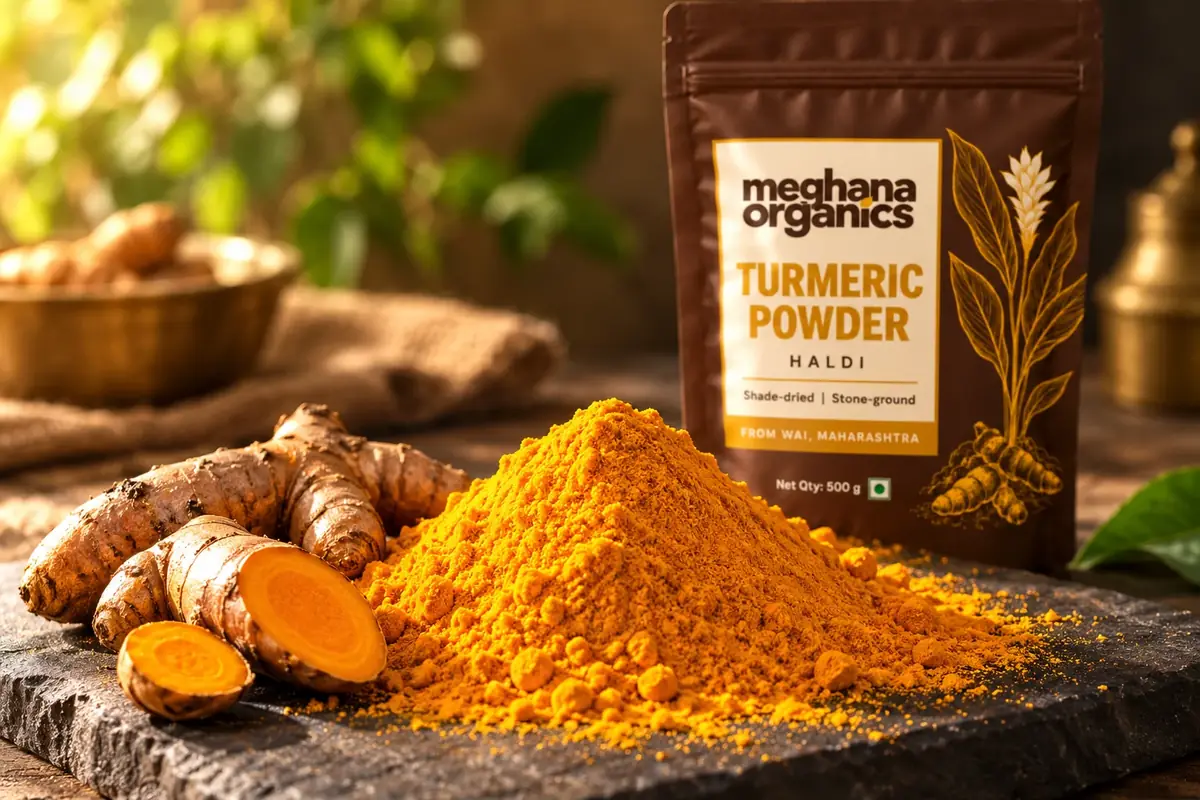
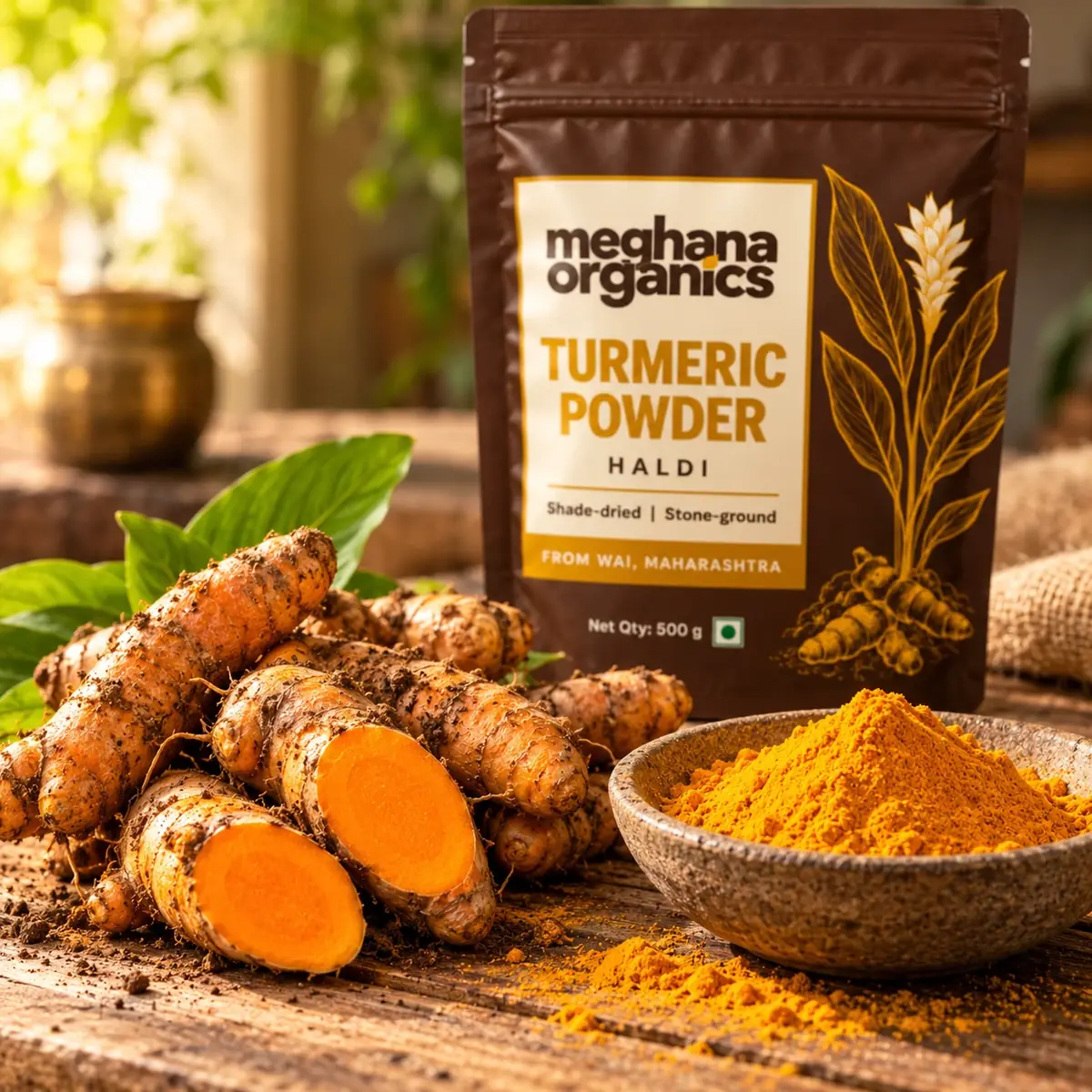
We sell one product, Turmeric Powder (Haldi), and pack only haldi from our family's farm in Wai, in Satara district, Maharashtra. As the pack and this site say, it is harvested, boiled, shade-dried and stone-ground, with no added colour, fillers or preservatives, and the pack reads "From Wai, Maharashtra". It comes in packs of 250 g (₹199), 500 g (₹299) and 1 kg (₹499), with delivery across India at ₹79 per order, free on orders of ₹999 or more. If a pack arrives damaged or you receive the wrong item, we replace it or refund you (see Refunds & Cancellations).
We have not published a lab report for our haldi yet, so we cannot show you a lead figure. Until we do, hold our pack to the same checks as any other.
Sources
- Forsyth et al., Evidence of turmeric adulteration with lead chromate across South Asia, Science of the Total Environment (2024)
- Lok Sabha, Unstarred Question No. 1187, Adulteration in Turmeric (answered 9 February 2024): FSSAI's 2022 surveillance of spices
- Toxics Link, press release on its study Lead in Turmeric (30 July 2026)
- FSSAI (Eat Right India), DART: Detect Adulteration with Rapid Test, spices tests 14 to 16
- FSSAI, Labelling and Display Regulations, 2020 (compendium, July 2022)
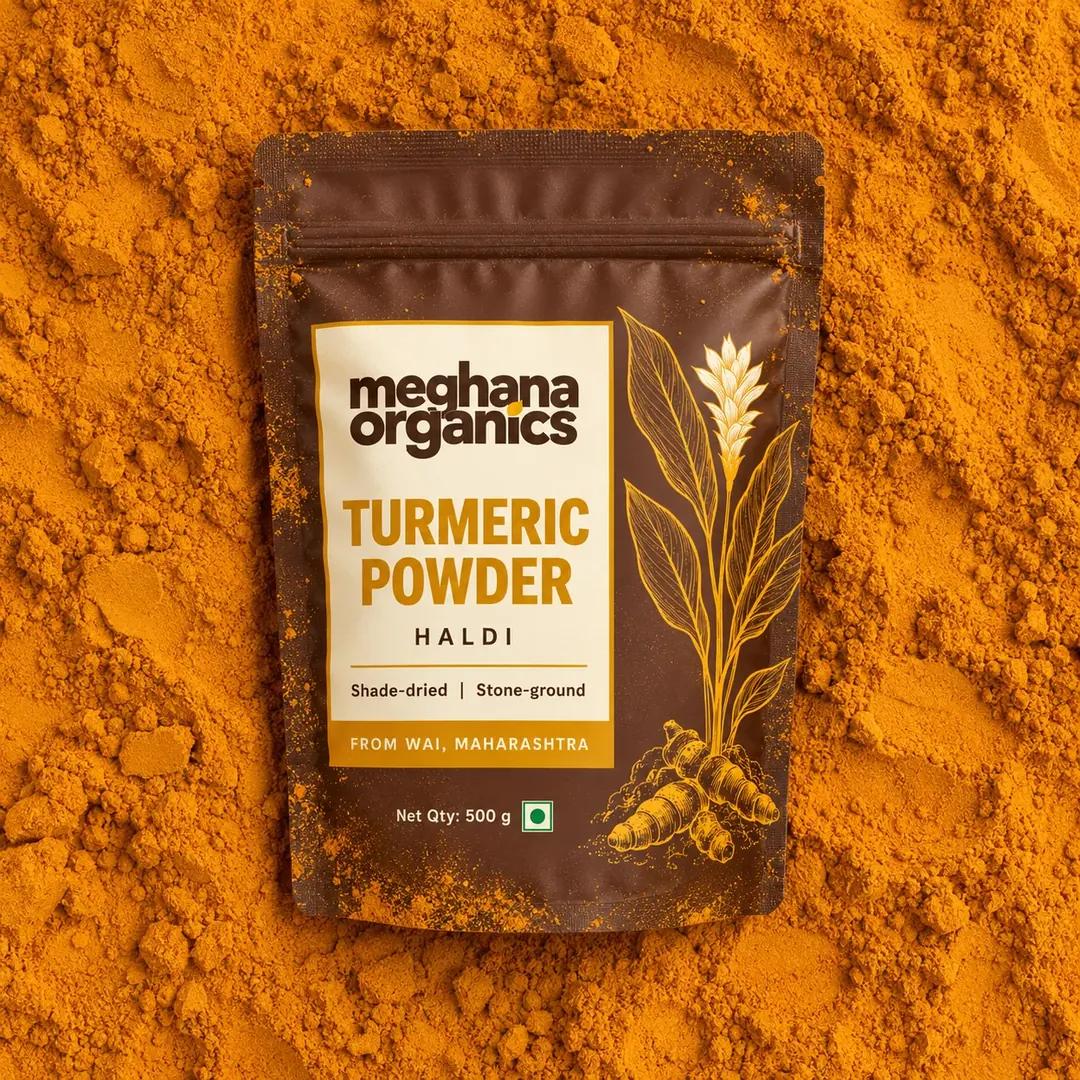
Turmeric Powder (Haldi)
From our family farm in Wai, Maharashtra. Shade-dried and stone-ground, with nothing added. 250g ₹199, 500g ₹299, 1kg ₹499.
Written by Meghana Organics Team
We are the family behind Meghana Organics. Our haldi grows on our farm in Wai, Maharashtra, and we cook with it every day. Here we write about how it is made, how to choose and store it, and how we use it.