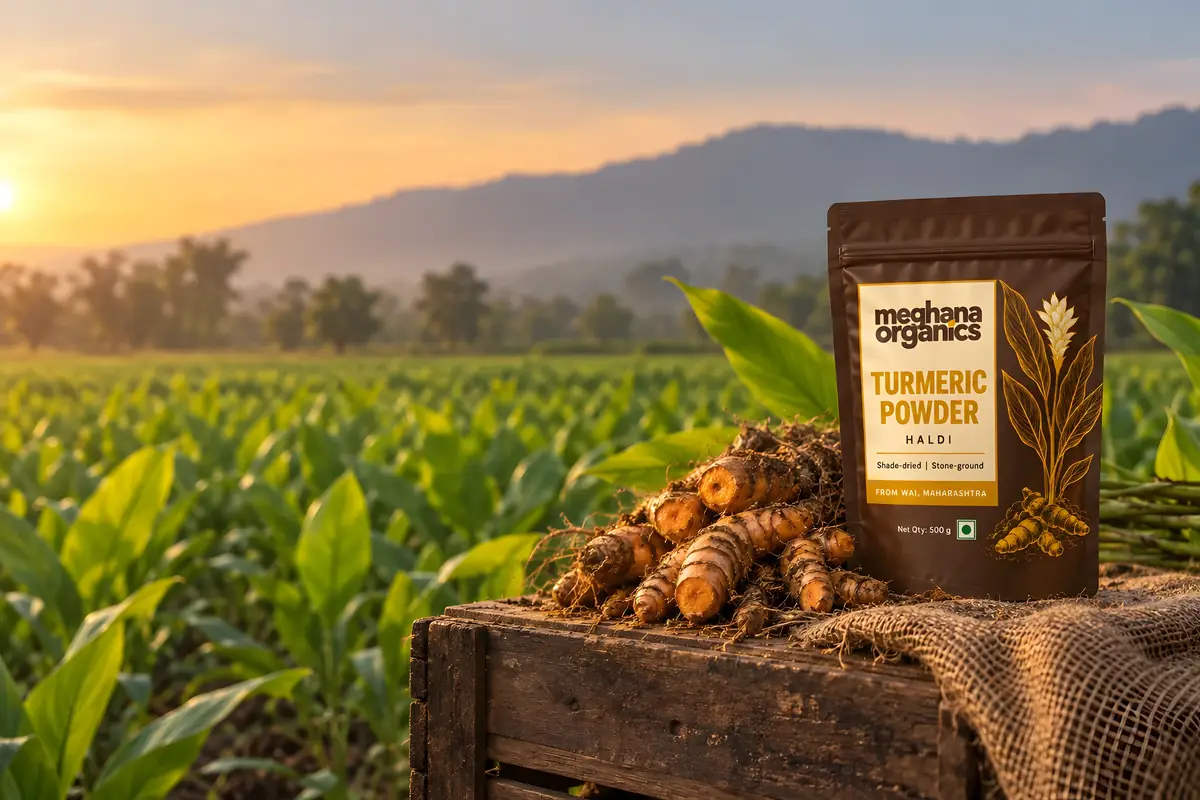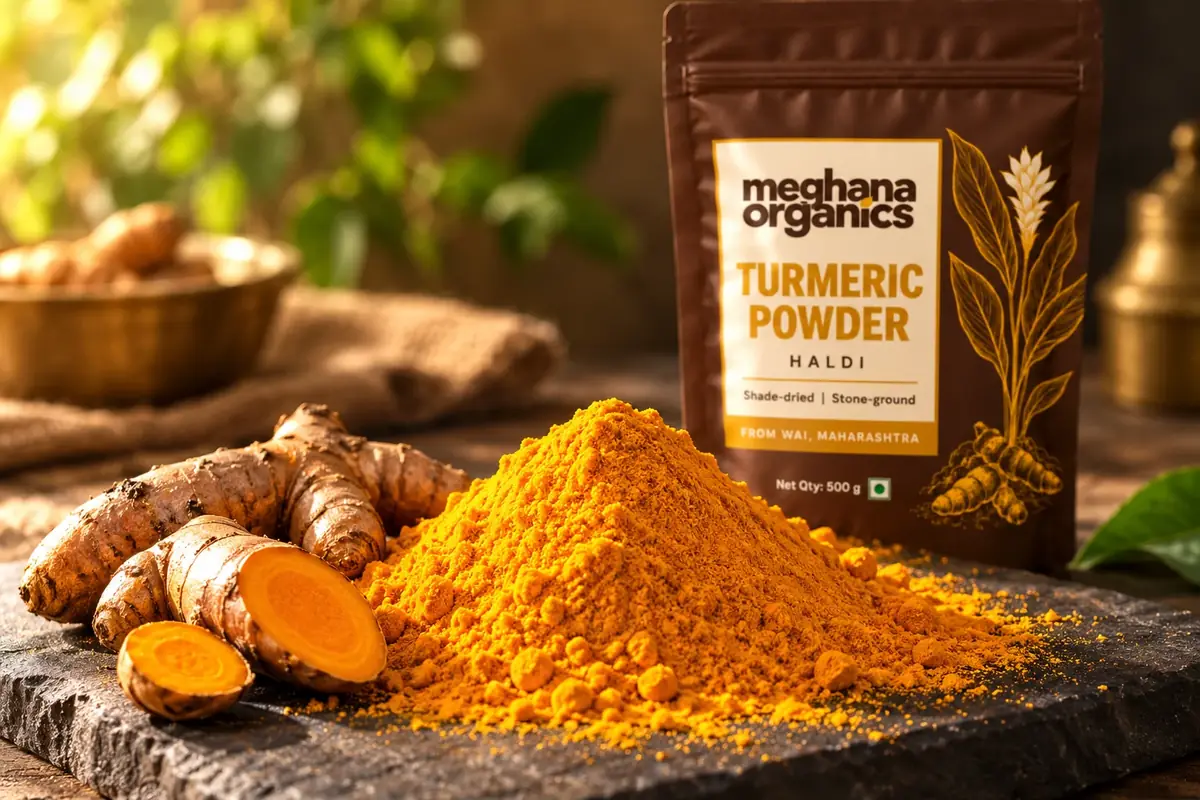
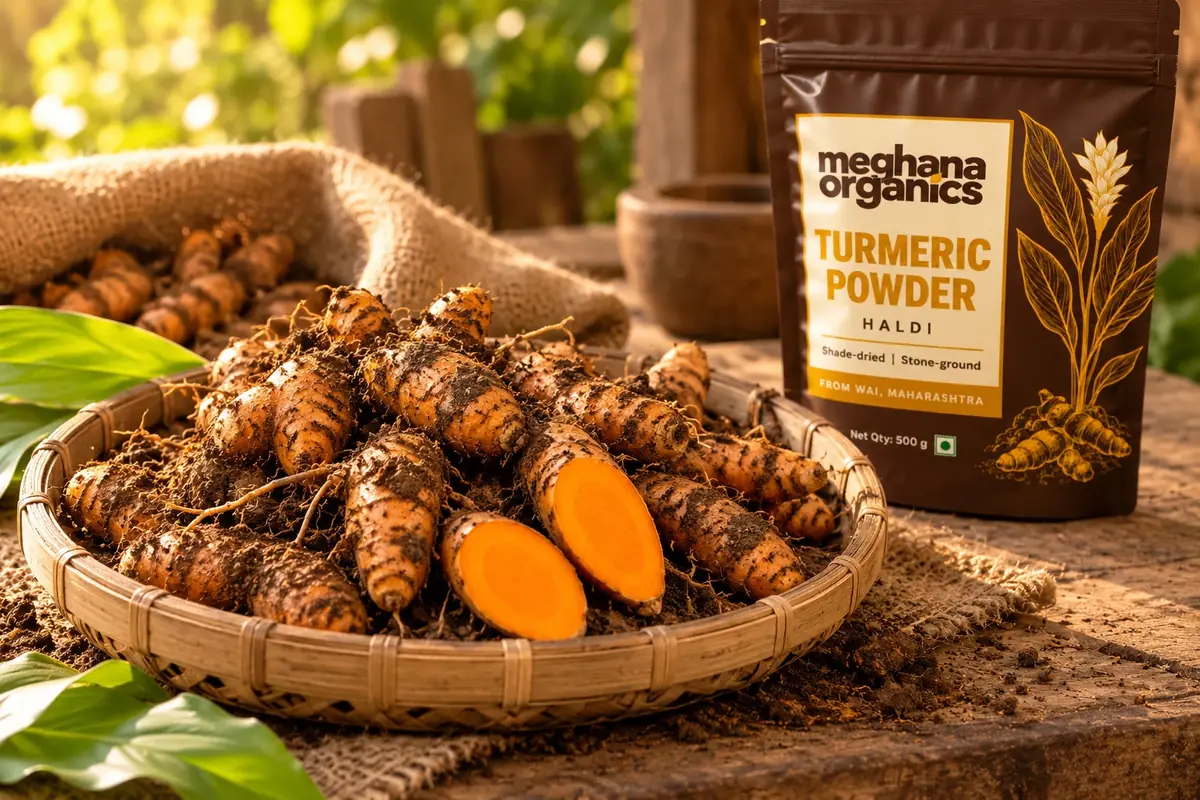
Yes, whole turmeric roots should be boiled before drying: it is the standard method in India, and the ICAR-Indian Institute of Spices Research (IISR) calls it an essential step. Boiling shortens the drying, gives the root one even colour all the way through and takes away its raw smell. In IISR trials, a boil of up to an hour left curcumin within 0.2 percentage points of turmeric that was sliced and dried without boiling, while a 90-minute boil lost more.
Slicing the roots thin and drying them unboiled is the main alternative. Slices dry fastest, and their curcumin and aroma oils came out close to boiled turmeric's: a little lower in one trial and a little higher in another. Below are the figures, and why our family boils its haldi (turmeric).
What boiling does, and why farmers do it
Turmeric that has been boiled and then dried is called cured, and that is how most of it reaches the market: IISR's pamphlet describes the turmeric of commerce as the cured and dried rhizome. Boiling is the first job after harvest, within three or four days of digging, and the roots cook in water until they are soft. Our guide to how haldi powder is made follows every stage from harvest to packet.
The IISR pamphlet and papers give the reasons:
- Faster drying. Boiling cooks the starch in the root. As the cooked starch dries it shrinks and opens up spaces between the cells, so water escapes sooner.
- Even colour. A boiled root dries to one colour all the way through.
- No raw smell. Boiling takes away the raw odour of the root as it comes out of the ground, one reason turmeric powder smells different from kachi haldi, the raw root.
- Easier grinding. The 2018 IISR paper notes that boiled roots are easier to grind than unboiled ones.
How long to boil is where advice differs. The Tamil Nadu Agricultural University (TNAU) Agritech portal gives 15 to 20 minutes, until the roots turn soft. The IISR pamphlet gives 45 to 60 minutes for fingers, the side branches, and 90 minutes for the larger mother rhizomes. TNAU adds that over-cooking spoils the colour, under-cooking leaves the dried root brittle, and the moment boiling stops largely decides the colour and aroma of the finished turmeric.
Sliced and dried, or boiled and then dried
The alternative to boiling is to cut the roots into thin slices and dry them raw. Two IISR trials set the methods side by side in the sun: 3 mm slices against whole roots boiled for 40 to 90 minutes in 2016, and 5 mm slices against whole roots boiled or steamed for an hour in 2018.
Slices dried fastest both times. A thin slice gives water less distance to travel, and the 2016 paper found that turmeric dries at the pace water can move from the inside of each piece to its surface. On quality the two methods came out close. In 2016 the roots boiled for 40 minutes had slightly more curcumin and aroma oil than the slices; in 2018 the slices had slightly more of both.
Slicing does change the product. The trade grades and sells whole dried pieces (fingers, bulbs and splits), and those are boiled. For powder, the shape of the dried piece matters less.
If you are drying kachi haldi at home, both routes work. Boil whole fingers until a skewer goes in with slight pressure, or slice them thin and skip the boil. Then dry them on a clean surface, turn them now and then so they dry evenly, and watch for mould, as the IISR pamphlet advises for drying on the farm.
How long turmeric takes to dry
Boiled fingers dried in the sun take 10 to 12 days to fall below 12% moisture, according to the IISR pamphlet; the TNAU portal says 10 to 15 days. Both advise spreading them 5 to 7 cm deep, because a thinner layer can spoil the colour, and heaping or covering them at night.
In the trials:
- Roots boiled for 40, 60 or 90 minutes all took 11 days in the 2016 IISR trial, and roots boiled for an hour took 10 days in 2018.
- Steaming was slow when it was short. Roots steamed for 30 minutes took 24 days, against 12 days after 60 minutes of steam. The 2016 paper explains that a longer cook softens the tissue and lets water out faster.
- Unboiled slices were quickest: 9 days at 3 mm in 2016, and 5 days at 5 mm in 2018.
- In a dryer at 60°C, in a 2022 trial at Uttar Banga Krishi Viswavidyalaya (UBKV) in West Bengal, whole fingers took 29 hours unboiled and 26 hours after a 45-minute boil.
None of these trials dried whole, unboiled roots in the sun, so we have no figure for that.
What is kept: curcumin, aroma oils and colour
The trials measured curcumin, the yellow pigment; essential oil, which carries the aroma; and the colour of the powder.
Curcumin
How long the roots were boiled mattered more than whether they were boiled. In the 2016 IISR trial, roots boiled for 40 minutes kept 5.91% curcumin, 60 minutes 5.85% and 90 minutes 5.12%, and the paper found that curcumin and aroma oil both fell as the cooking time grew. Against unboiled turmeric, a boil of up to an hour came out close every time: a little ahead of the slices in 2016, a little behind them in 2018, and 4.19% against 4.31% for unboiled whole fingers at UBKV.
Aroma oils
Essential oil followed cooking time too. In 2016 the 40- and 60-minute boils kept the most, 3.60%, and the 90-minute boil dropped to 3.33%. Against unboiled turmeric the results went both ways: boiled roots had more than the slices in 2016 (3.60% against 3.07%), the slices had more in 2018 (6.23% against 5.87%), and at UBKV boiled and unboiled whole fingers were almost level (3.33% against 3.28%).
Colour
Boiling evens out the colour through the root, and at UBKV the powder from unboiled fingers was the least yellow of all the samples. The authors point to enzymes in the raw root that can turn it dark brown, which heat before drying can switch off.
The trial results side by side
Each row is one trial's result, as the paper reports it. The trials used different varieties and lab methods, and curcumin depends on the variety as well as the processing, as the UBKV paper notes. So compare rows within a trial, not across trials.
| Method | Typical drying days | Curcumin (as reported) | Aroma oils (as reported) |
|---|---|---|---|
| IISR 2016: boiled whole for 40 min, dried in the sun | 11 | 5.91% | 3.60% |
| IISR 2016: boiled whole for 60 min, dried in the sun | 11 | 5.85% | 3.60% |
| IISR 2016: boiled whole for 90 min, dried in the sun | 11 | 5.12% | 3.33% |
| IISR 2016: sliced 3 mm, not boiled, dried in the sun | 9 | 5.71% | 3.07% |
| IISR 2018: boiled whole for 60 min, dried in the sun | 10 | 3.65% | 5.87% |
| IISR 2018: sliced 5 mm, not boiled, dried in the sun | 5 | 3.74% | 6.23% |
| UBKV 2022: boiled whole for 45 min, dryer at 60°C | 26 hours | 4.19% | 3.33% |
| UBKV 2022: whole, not boiled, dryer at 60°C | 29 hours | 4.31% | 3.28% |
Why our family boils
Our haldi comes from our family's farm in Wai, in Satara district, Maharashtra; you can read about the town in Wai, where our turmeric grows. It is boiled, shade-dried and stone-ground, with no added colour, fillers or preservatives.
Boiling is part of how our family makes its haldi, as it is for most turmeric in India, and it does the same jobs on our farm as anywhere else: one colour all the way through the root, no raw smell, and roots that grind more easily. After boiling, the roots dry in the shade, out of direct sun, and are then ground on stone.
We haven't had our roots measured before and after boiling, so there is no row for our haldi in the table, and we won't guess at one. The pack sizes and prices are on the Turmeric Powder (Haldi) page.
About "never boiled" labels
Some turmeric is sold as never boiled, with the suggestion that boiling strips out curcumin or aroma. The trials above don't support that as a rule. A boil of up to an hour left curcumin within 0.2 percentage points of unboiled turmeric each time, and boiled roots had as much aroma oil or more in two of the three trials. What did cost curcumin and oil was a long cook.
That doesn't make unboiled turmeric bad: slicing and drying is a tested method. But "never boiled" describes one step. It tells you nothing about the variety, how well the roots were dried, how they were ground or whether colour was added. For any pack, ours included, ask how a curcumin figure was measured; our guide to curcumin in turmeric powder explains what to look for.
Sources
- ICAR-Indian Institute of Spices Research (E Jayashree and T John Zachariah), "Processing of turmeric (Curcuma longa) by different curing methods and its effect on quality", Indian Journal of Agricultural Sciences 86(5), 2016
- ICAR-Indian Institute of Spices Research (E Jayashree, T J Zachariah and R Rakhi), "Comparison of quality of dry turmeric (Curcuma longa) produced by slicing and other curing methods", Journal of Spices and Aromatic Crops 27(2), 2018
- Uttar Banga Krishi Viswavidyalaya (Tshering Ongchu Lepcha, Shrilekha Das, Babli Dutta and P S Medda), "Effect of curing methods on quality and drying characteristics of turmeric", Journal of Spices and Aromatic Crops 31(1), 2022
- ICAR-Indian Institute of Spices Research, Turmeric extension pamphlet, March 2022 (post-harvest processing), hosted by Spices Board India
- Tamil Nadu Agricultural University, TNAU Agritech Portal: Turmeric (post-harvest treatment)
Turmeric Powder (Haldi)
From our family farm in Wai, Maharashtra. Shade-dried and stone-ground, with nothing added. 250g ₹199, 500g ₹299, 1kg ₹499.
Written by Meghana Organics Team
We are the family behind Meghana Organics. Our haldi grows on our farm in Wai, Maharashtra, and we cook with it every day. Here we write about how it is made, how to choose and store it, and how we use it.