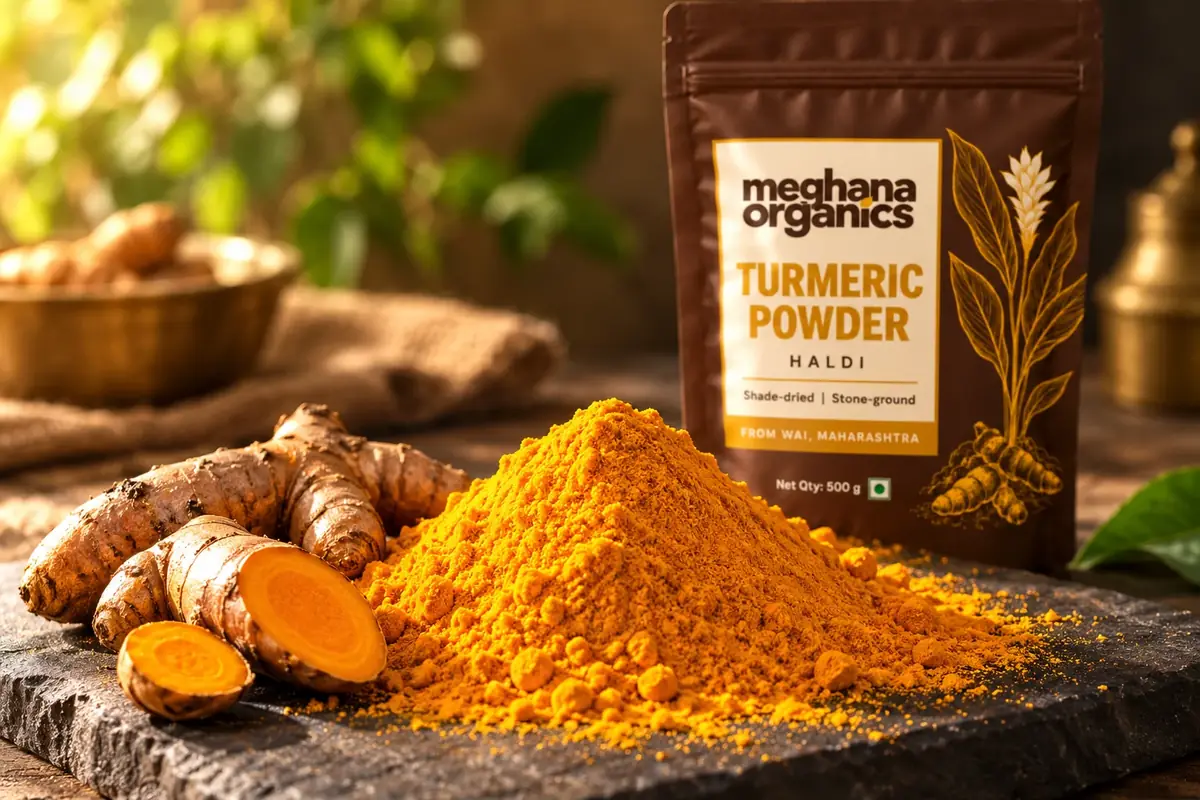
Grinding heats turmeric, and heat drives off its volatile oil, the part that gives haldi (turmeric) its earthy aroma. Indian trials of hammer mills and chilled grinding found that a cooler grind kept more of that oil, while curcumin, the yellow pigment, is more sensitive to light than to heat. We found no study that directly compares a stone chakki with a pulveriser for turmeric, so the idea that stone grinding keeps more aroma or curcumin is, as far as we can tell, untested.
A chakki can have a motor too, so in this guide "machine-ground" means high-speed impact mills such as hammer mills, pin mills and pulverisers.
The kinds of mills
The target is a fine powder: ICAR-IISR (the Indian Institute of Spices Research) gives about 60 to 80 mesh, or 250 to 177 microns. A 2018 paper from the Indian Institute of Food Processing Technology in Thanjavur names plate mills and hammer mills as the mills traditionally used for turmeric in India.
Stone chakki
A chakki (stone mill) grinds between two round stones, one turning against the other. The spice is rubbed and sheared between the stone faces rather than smashed, and the fineness depends on the gap between the stones and on the sieve. Engineers class it with plate mills, which work the same way with two discs.
Hammer mill or pulveriser
In a hammer mill, hammers spin at high speed inside a chamber and break the spice by impact, and a screen sets how fine the powder comes out. One study below calls its hammer mill a micro pulveriser, which is the sense we use here. A pin mill is a close relative, with pins in place of hammers.
Cryogenic grinding
Cryogenic grinding chills the spice with liquid nitrogen and grinds it frozen. In a 2014 turmeric study from ICAR's Central Institute of Post-Harvest Engineering and Technology in Ludhiana, the grinder ran below −50°C. The cold makes the spice brittle, so it breaks easily. It is also expensive: the Thanjavur paper notes that it has not been commercialised much in India.
Chilled grinding
A cheaper middle path cools the spice or the mill instead. The Thanjavur team chilled dried turmeric before grinding it in an ordinary mill, and built a unit that does the chilling with cold water. A 2007 study tested a hammer mill with a cooling jacket.
Why heat matters for turmeric
Turmeric's aroma is in its volatile oil. As the Thanjavur paper puts it, volatile oils give spices their aroma, while oleoresins carry the taste. Volatile means the oil evaporates easily, and the paper explains its own losses this way: grinding generates heat, and the heat makes the volatiles evaporate. The Ludhiana paper names essential oils, aroma and colour as what is lost when the powder gets hot.
Curcumin is a different case. ICAR-IISR notes that curcuminoids, turmeric's colour compounds, deteriorate with light and, to a lesser extent, with heat and oxidation, which is why it advises light-protective packaging for ground turmeric. So grinding heat matters most for aroma; for curcumin and colour, what happens after grinding, in the pack and the kitchen, matters as well.
What the studies show
- Ordinary grinding runs hot. The Ludhiana paper notes that in ambient (room-temperature) grinding the powder can reach as high as 90 to 95°C. The Thanjavur paper, citing a food-processing textbook, gives 42 to 95°C for the plate and hammer mills used for turmeric, and says this loses flavour, aroma and volatile oil.
- A hammer mill, measured. A 2015 study measured hammer-milled turmeric powder at an average of 38 to 54°C when ground in a single stage and 35 to 48°C in two stages. The two-stage powder was finer and kept 75 to 80% of its volatile oil, 72 to 75% of its curcumin and 85 to 90% of its oleoresin, which the authors put at 15 to 25% more than single-stage grinding.
- Chilling first keeps more oil. In the Thanjavur trial, dried turmeric holding 6% volatile oil went through a pin-and-hammer mill. Fed in at room temperature (30°C), the powder reached 70°C and kept 2.5% volatile oil (the paper's text gives 71°C and 3%). Chilled to 5°C first, it kept 4.5%, needed less energy and came out finer and more yellow.
- Mills heat up differently. The 2007 study ground turmeric and cumin in five mills. The biggest temperature rise, 60°C, came in a pin mill, which also gave the finest turmeric powder, 0.0452 mm. The smallest, 38°C, came in the hammer mill with a cooling jacket.
- Cryogenic grinding and colour. In the Ludhiana study, turmeric ground with liquid nitrogen was lighter and less reddish than turmeric from a hammer mill, and the authors rated its colour better.
These studies point the same way: a cooler grind keeps more aroma oil. Curcumin has been measured less often, but in the 2015 study it, too, changed with the way the mill was run. None of this makes machine-ground powder poor: how a mill is run, in one stage or two, with or without cooling, changes the result.
What is not known
We looked for a study that grinds turmeric in a stone chakki and in a pulveriser side by side and measures the temperature, volatile oil or curcumin. We did not find one, and we found no published grinding temperature for turmeric in a stone mill.
The nearest is the 2007 five-mill study. It included a burr-type mill, which grinds between two plates much as a chakki does, but its abstract names only the hottest and coolest mills, and the burr mill was neither. The Thanjavur paper puts plate mills, the family a chakki belongs to, alongside hammer mills as mills that run hot, without a separate figure for them.
So "stone-ground" on a pack, ours included, tells you how the spice was made. It is not a measured result. Each trial used its own turmeric, mill and moisture levels, so the numbers do not carry over neatly. And none of the studies we read asked cooks to taste the difference in a dal (lentil curry).
Stone and machine grinding compared
Where we found no measurement, the table says so.
| Method | Typical grinding temperature | Effect on aroma oils/curcumin (as studies report) | Texture | Output |
|---|---|---|---|---|
| Stone chakki | No published figure for turmeric that we could find | Not measured for turmeric in any study we found | Set by the gap between the stones and by sieving | From a household stone to a motorised flour-shop mill; no turmeric figures found |
| Hammer mill or pulveriser | Averages of 38 to 54°C single-stage and 35 to 48°C two-stage (2015 study); as high as 90 to 95°C in ambient grinding (Ludhiana paper) | Two-stage grinding kept 75 to 80% of volatile oil and 72 to 75% of curcumin, 15 to 25% more than single-stage | Fine; two stages gave a finer powder | Traditionally used for turmeric in India, with plate mills |
| Pin mill | Biggest rise of five mills, 60°C (2007 study); 70°C in a pin-and-hammer mill fed at room temperature (Thanjavur) | Pin-and-hammer mill at room temperature left 2.5% volatile oil of 6% (3% in the paper's text) | Finest of five mills: 0.0452 mm | The Thanjavur pin-and-hammer mill was rated at 40 kg an hour |
| Chilled feed or cooled mill | Smallest rise of five mills, 38°C, in a hammer mill with a cooling jacket (2007 study) | Turmeric chilled to 5°C kept 4.5% volatile oil of 6%, and the powder was more yellow | Finest in the Thanjavur trial: 0.299 mm average at 5°C | Trial stage: an 8 kg batch pre-cooler, more economical than cryogenic grinding, its authors say |
| Cryogenic grinding | Below −50°C, with liquid nitrogen (Ludhiana study) | Used to retain volatile oil, flavour and colour; colour rated better in the Ludhiana study | Finer and more brittle than hammer-milled powder | Expensive; not commercialised much in India |
How our haldi is made
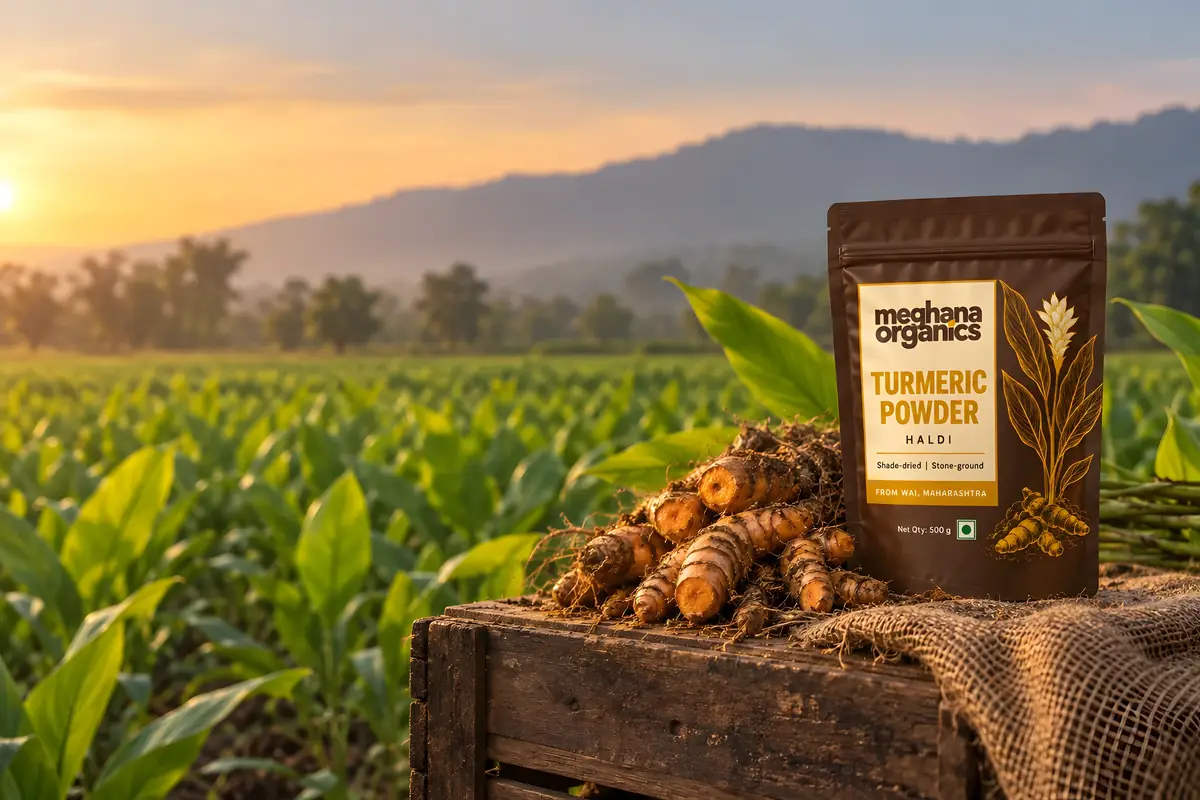
Our haldi comes from our family's farm in Wai, in Satara district, Maharashtra. The roots are harvested, boiled, dried in the shade and stone-ground, with no added colour, fillers or preservatives. Each step, set against the usual process, is in how haldi powder is made.
We have not published a grinding temperature or a lab report for our powder, so we give no number here. Nor will we claim that stone grinding keeps more curcumin than a pulveriser, because, as far as we can find, nobody has tested that. What the studies do support: a cooler grind keeps more aroma oil, and once haldi is packed, light is the bigger risk to curcumin.
Two habits help with any haldi, ours included. Rub a pinch between your fingers: the earthy smell comes from the volatile oil, so it is a rough guide to how much is left. Then store it in an airtight, opaque container away from the stove, as our guide to storing turmeric explains. For what a curcumin figure on a pack means, see curcumin in turmeric powder. Our packs are on the Turmeric Powder (Haldi) page.
Sources
- Barnwal, Mohite, Singh and Kumar (ICAR-Central Institute of Post-Harvest Engineering and Technology, Ludhiana), Selected physico-mechanical characteristics of cryogenic and ambient ground turmeric, International Agrophysics 28: 111-117 (2014)
- Shanmugasundaram, Sekar, Swaminathan, Pandian and ArunMouli (Indian Institute of Food Processing Technology, Thanjavur), Low temperature grinding of turmeric, Agricultural Engineering International: CIGR Journal 20(3): 215-220 (2018)
- Choudhary, Garg, Bawankar, Chavan and Singh, Influence of single- and double-stage hammer grinding on quality attributes of turmeric powder, Journal of Agricultural Engineering (ISAE) 52(3): 9-15 (2015), abstract
- Agrawal, Singh and Singh, Effect of grinding method on rise in temperature during grinding of spices, Journal of Food Science and Technology (2007), abstract (University of Melbourne listing)
- ICAR-Indian Institute of Spices Research (Alfiya P V, Jayashree E and Anees K), "Turmeric: golden spice to value-added treasure", Indian Horticulture 70(4), 2025
Turmeric Powder (Haldi)
From our family farm in Wai, Maharashtra. Shade-dried and stone-ground, with nothing added. 250g ₹199, 500g ₹299, 1kg ₹499.
Written by Meghana Organics Team
We are the family behind Meghana Organics. Our haldi grows on our farm in Wai, Maharashtra, and we cook with it every day. Here we write about how it is made, how to choose and store it, and how we use it.