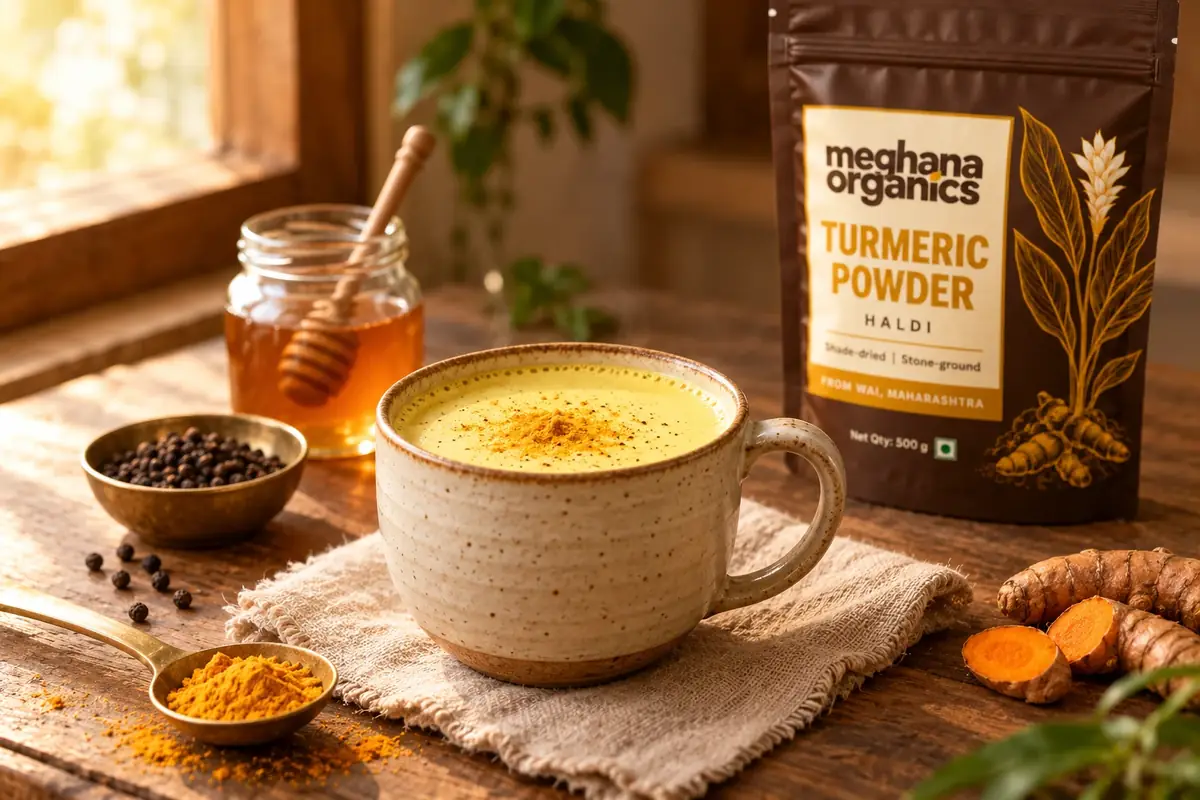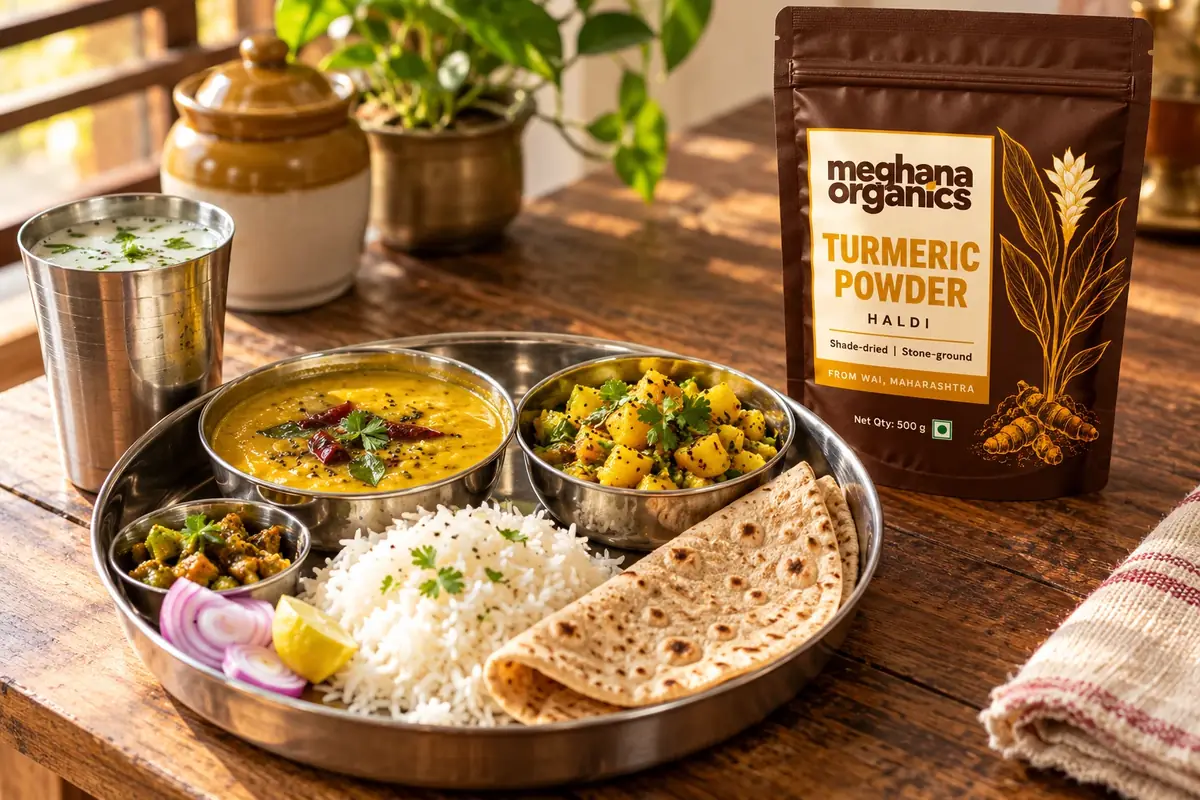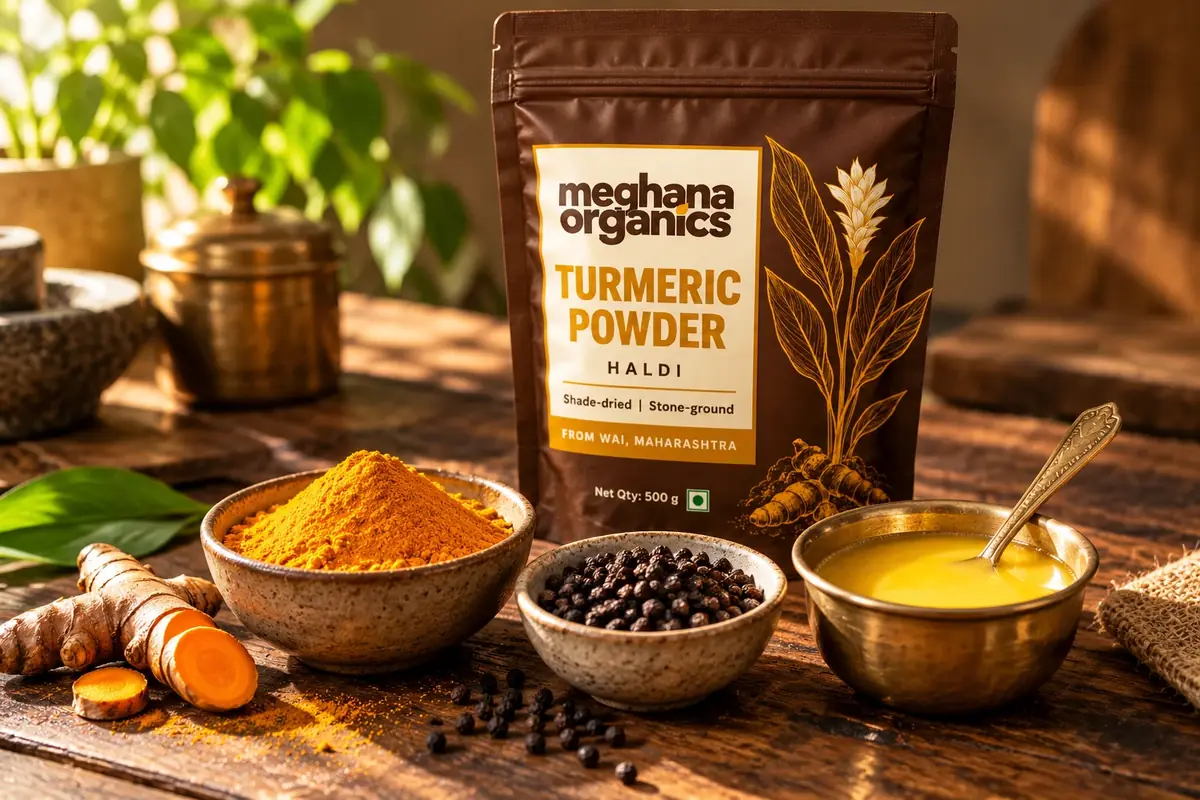
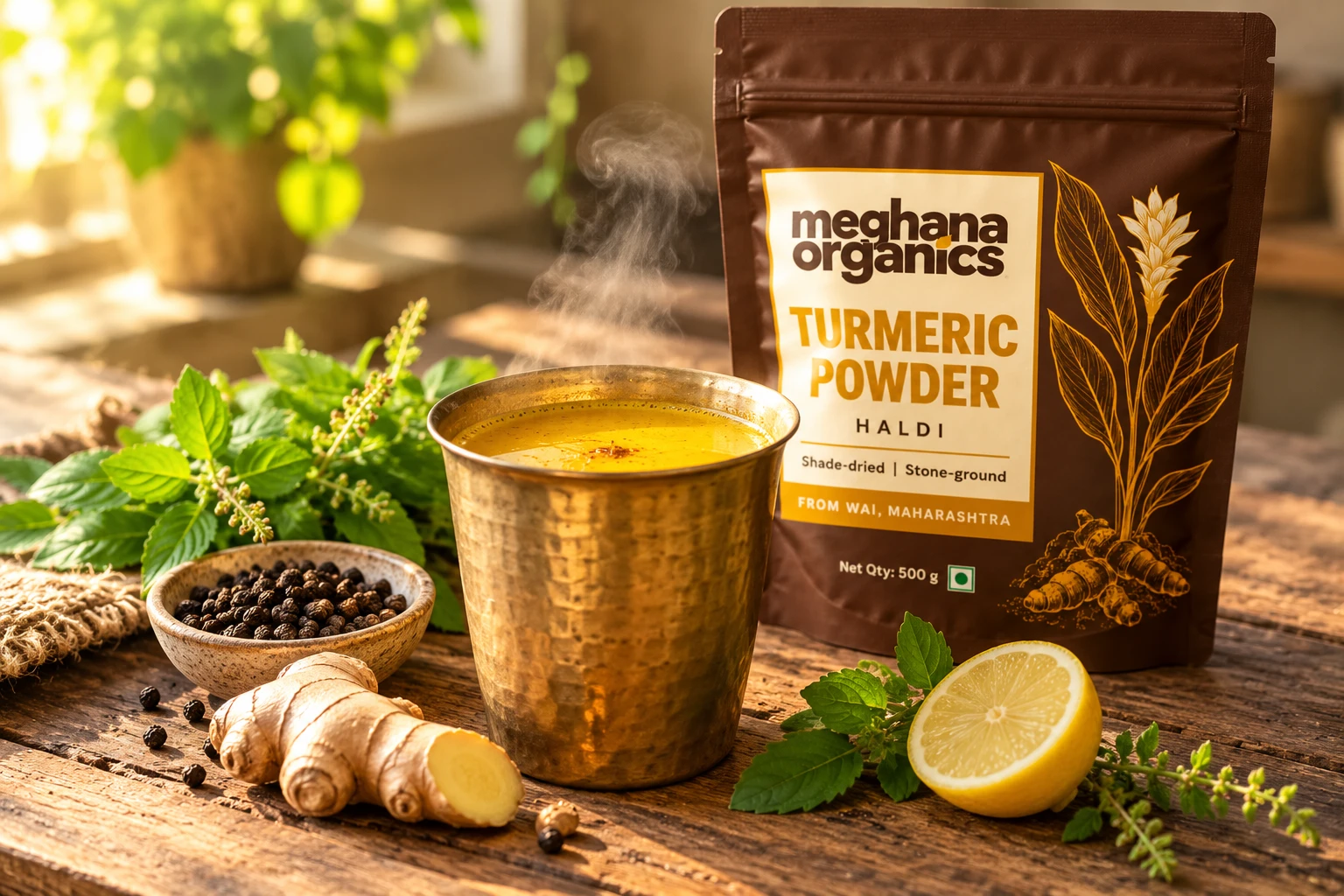
Haldi kadha is a spiced drink made by simmering haldi (turmeric powder), tulsi (holy basil) leaves, ginger and crushed black pepper in water for 10 to 12 minutes, then straining it and stirring in jaggery or honey once it has cooled a little. For 2 cups you need 3 cups of water, ½ teaspoon of haldi, 10 to 12 tulsi leaves, a 2.5 cm piece of ginger and 6 to 8 peppercorns. In many Indian homes it is a traditional winter drink, sipped warm on chilly evenings.
Below are the recipe with amounts and simmer times, four variations including a milder cup, how strong to make it, and where kadha sits in Ayurveda.
Haldi kadha recipe
Makes: about 2 cups (500 ml). Time: 5 minutes to prepare, 15 to 17 minutes on the stove, and 5 minutes to rest and cool.
Ingredients
- 3 cups (750 ml) water
- ½ teaspoon haldi (turmeric powder)
- 10 to 12 tulsi leaves, rinsed
- A 2.5 cm (1 inch) piece of ginger (adrak), peeled
- 6 to 8 black peppercorns (kali mirch)
- Optional: a 2.5 cm piece of cinnamon (dalchini) or 2 cloves (laung)
- 2 to 3 teaspoons jaggery (gur) powder or honey, to taste, added once the kadha has cooled a little
Method
- Coarsely crush the peppercorns in a mortar and pestle (khalbatta in Marathi), then crush the ginger in it too, or grate it. Tear any large tulsi leaves in half. If you are using cinnamon, break it into two or three pieces.
- Put the water, ginger, pepper and cinnamon or cloves in a saucepan and bring it to a boil over medium-high heat, about 5 minutes.
- Stir in the haldi and turn the heat down to medium so the kadha bubbles steadily. Simmer uncovered for 5 minutes. This takes away the raw taste of the haldi and lets the ginger and pepper flavour the water.
- Add the tulsi leaves and simmer for another 5 to 7 minutes, until about 2 cups remain and the kadha is a deep golden colour. Adding the leaves late keeps more of their aroma. If it reduces too far, add a splash of hot water.
- Switch off the heat, cover the pan and let it stand for 2 minutes. Strain through a fine tea strainer into two cups, pressing on the ginger and leaves with a spoon.
- Let it cool for 2 to 3 minutes, until it is warm rather than hot, then stir in the jaggery or honey until it dissolves. Honey is traditionally not heated, which is why it goes in last. Some haldi always settles at the bottom, so stir before the last sips.
Haldi that never meets heat tastes raw and slightly bitter. Our guide to using turmeric powder in cooking covers when to add it in everyday dishes. Any good haldi works in this recipe. Ours, Turmeric Powder (Haldi) from our family farm in Wai, Maharashtra, is boiled, shade-dried and stone-ground, with no added colour, fillers or preservatives.
Four variations
Without tulsi
Skip the tulsi and keep everything else the same, for a sharper cup of haldi, ginger and pepper. If you have dried tulsi, 1 teaspoon of it can replace the leaves at step 4. Or add 5 or 6 mint (pudina) leaves for the last 2 minutes, for a different, cooler taste.
A milder kadha
For a gentler cup, use 3 or 4 peppercorns and half the ginger, and leave out the cloves. Simmer for the same times and sweeten to taste. If that is still too sharp, make haldi doodh (turmeric milk) instead: the milk softens the spice, and it uses the same ¼ teaspoon of haldi per cup.
With dry ginger (sonth)
If you have no ginger root, use ¼ teaspoon of dry ginger powder (sonth) and add it with the haldi at step 3. Its heat is a little different. ICAR-IISR, the Indian Institute of Spices Research, notes that the bite of ginger comes from gingerols and shogaols, and that shogaols form from gingerols as ginger dries.
With raisins and lemon
The kadha in the Ministry of AYUSH's 2020 self-care list is made from tulsi, dalchini, kali mirch, shunthi (dry ginger) and munakka (large raisins), with jaggery or lemon juice, or both, to taste. It has no haldi: that list puts haldi in everyday cooking and in hot milk. To bring this recipe closer to it, use cinnamon rather than cloves, add 5 or 6 munakka, slit open, at step 2, and finish each cup with a squeeze of lemon juice. The raisins sweeten it, so taste before adding jaggery.
How strong to make it
One cup at a time is plenty. At these amounts each cup holds about ¼ teaspoon of haldi, the same as a cup of haldi doodh: a kitchen amount.
A stronger kadha is not a better one. More pepper, ginger or cloves mostly make it harsher, so keep to the amounts above and use the milder version if it still tastes too sharp.
Kadha in Ayurveda
The AYUSH list calls kadha a herbal tea or decoction: spices and leaves boiled in water until the water carries their flavour. Ayurveda also has a name for routines that change with the seasons, ritucharya, and in many Indian homes kadha belongs to winter, made on chilly evenings and sipped warm.
In Ayurveda, haldi (haridra in Sanskrit) is traditionally used to support immunity, and a cup of haldi kadha in winter is one everyday form of that tradition. Immune support is one of six traditional uses of haldi we write about, with digestive balance, joint comfort, anti-inflammatory support, skin glow support and antioxidant protection. Our immune support collection gathers more ways to use haldi like this.
Tulsi has its own place in Indian homes. A 2014 overview in the Journal of Ayurveda and Integrative Medicine describes how a Hindu household is traditionally thought incomplete without a tulsi plant, often grown in an earthen pot in the courtyard, and how its leaves are eaten or brewed as tea. It describes tulsi as tasting hot and bitter, with a clove-like aroma that comes from eugenol. Its author advises a company that sells tulsi products, so we rely on the overview for the tradition and the flavour, not for health claims.
Research is a separate matter. Most curcumin studies use concentrated extracts at doses far above the quarter teaspoon of haldi in a cup of kadha, so their results do not carry over to this drink, and studies of tulsi or ginger extracts are not a cup of kadha either. Make it for its taste, its warmth and the tradition behind it.
Storage: drink it the day you make it
Kadha is at its best within an hour or so of making it, while it is warm and the tulsi and ginger still smell bright, so make it as you need it rather than in bulk. If some is left over, strain it, let it cool, then cover it, keep it in the fridge and drink it the same day. Warm it gently in a pan without letting it boil hard, and add honey only after warming.
To save time, crush a few days' worth of pepper and cinnamon and keep them in a small, dry, airtight jar, adding the haldi, ginger and tulsi as you cook. Crushed spices lose their aroma faster than whole ones, so keep the batch small.
Kadha is a kitchen drink, not a medicine. If you are pregnant or nursing, take regular medication or have a health condition, check with your doctor before having more than cooking amounts of haldi.
Haldi kadha questions
Can I use kachi haldi instead of powder?
Yes. Grate about 1½ teaspoons of kachi haldi (turmeric root) in place of the ½ teaspoon of powder, add it with the ginger at step 2 and strain well. Wear gloves to peel it, because it stains.
Why is black pepper in haldi kadha?
For its bite, and because Indian kitchens often cook haldi with a pinch of kali mirch. The bite comes from piperine, which ICAR-IISR names as the main pungent compound in black pepper. Research links piperine with better absorption of curcumin, but most of it uses concentrated curcumin at doses far above a cup of kadha. Our post on black pepper and turmeric explains what one well-known study found.
Does haldi kadha have caffeine?
No. It is made from spices and leaves, with no tea or coffee, so it has no caffeine unless you add tea leaves. That makes it an easy cup for the evening.
Sources
- Ministry of AYUSH, via Press Information Bureau: Ayurveda self-care measures, including a kadha (31 March 2020)
- Cohen, Tulsi (Ocimum sanctum): a herb for all reasons, Journal of Ayurveda and Integrative Medicine (2014)
- ICAR-Indian Institute of Spices Research: Ginger (Zingiber officinale)
- ICAR-Indian Institute of Spices Research: Black pepper (Piper nigrum)
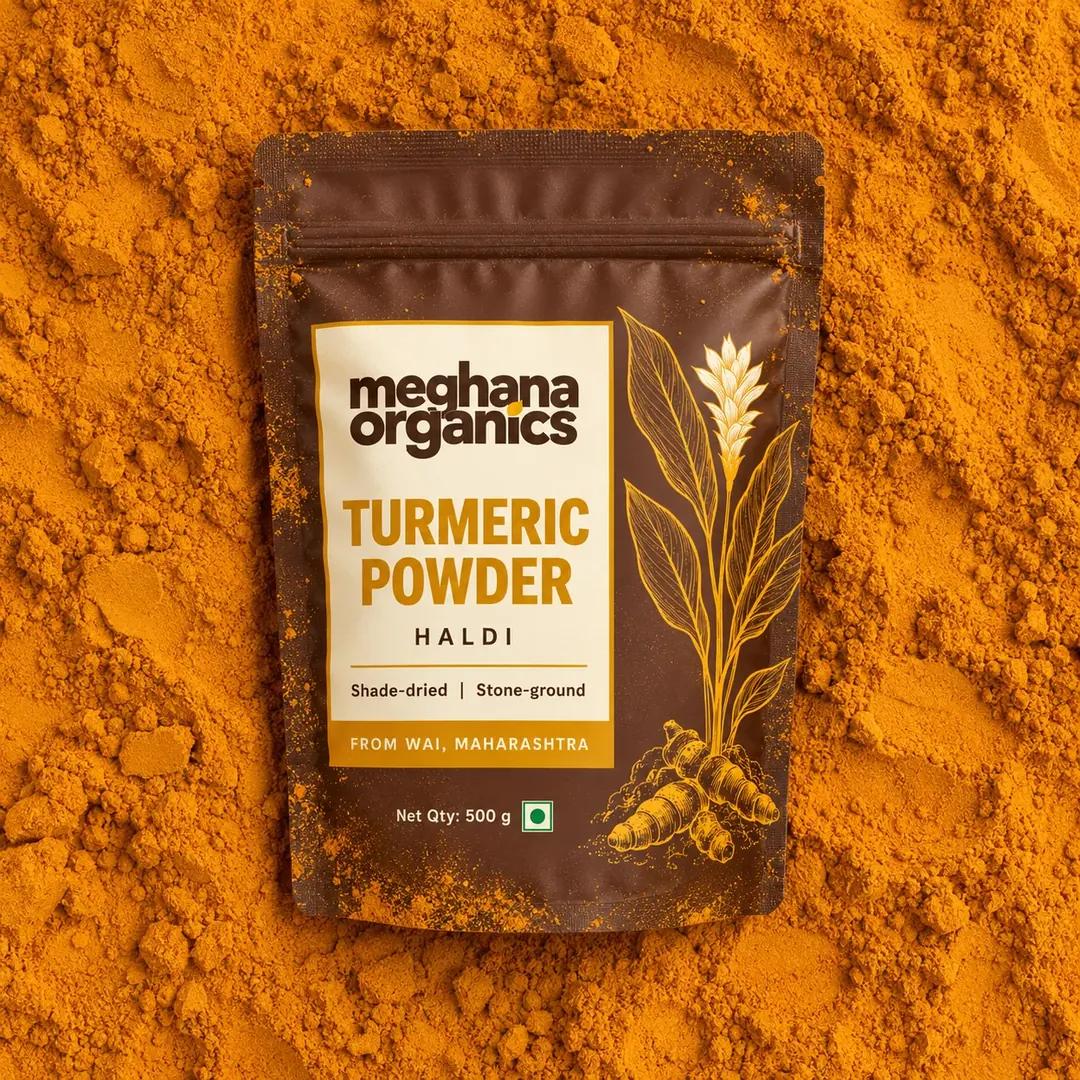
Turmeric Powder (Haldi)
From our family farm in Wai, Maharashtra. Shade-dried and stone-ground, with nothing added. 250g ₹199, 500g ₹299, 1kg ₹499.
Written by Meghana Organics Team
We are the family behind Meghana Organics. Our haldi grows on our farm in Wai, Maharashtra, and we cook with it every day. Here we write about how it is made, how to choose and store it, and how we use it.